

Red Mountain Mining Ltd (ASX:RMX) To Commence Trading on US Stock Exchange (RMXFF)
5 November 2025
Price Sensitive Announcement $
Highlights:
- Red Mountain Mining has recently appointed a highly regarded US-based markets advisory team and is in the final stages of confirming a US Stock Market listing on the OTCQB under the US Stock Code “RMXFF”
- In 2024, over US$478 billion (AU$732 billion) in liquidity and volume flowed through the
United States OTC Markets Group’s exchanges1 - Red Mountain has secured multiple US antimony assets in Tier-1 mining districts since midSeptember 2025, with projects located adjacent to high value, major Antimony projects, including Perpetua Resources’ (NASDAQ: PPTA, market cap. AU$4b) Stibnite Project in Idaho and Trigg Minerals’ (ASX: TMG, market cap. AU$180m) Antimony Canyon Project in Utah
- Red Mountain has also made significant progress at its Armidale Antimony-Gold Project in the New England Orogen in New South Wales, the location of Larvotto Resources’ (ASX: LRV, AU$540m market cap) Hillgrove project, which is Australia’s largest Antimony deposit and the target of a recent acquisition proposal by United States Antimony Corporation (NYSE: UAMY, AU$1.5b market cap.)
- Following highly encouraging inbound interest received from several US investment banks, the Red Mountain Board believes the planned US Stock Market listing provides a series of value accretive opportunities including:
o Providing US retail and institutional investors direct access to invest and trade in the Company’s shares on the OTCQB under the US Stock Code “RMXFF”
o Positioning RMXFF alongside US peers in the critical minerals sector, potentially further improving valuation metrics and attracting specialised US resources investors
o Improving Red Mountain’s current strong strategic alignment with the US Government’s dramatic push to secure a domestic supply of critical minerals, and better positioning the Company to benefit from strong US Federal financial support for critical mineral projects targeting antimony - Red Mountain expects to confirm the “RMXFF” listing date by next week
Overview:
Red Mountain Mining Limited, a critical minerals exploration and development firm with projects in premier mining jurisdictions across the United States and Australia, is pleased to announce significant progress toward a US stock exchange listing.
The Company has engaged a US-based markets advisory team and is finalizing its listing on the OTCQB under the ticker “RMXFF”.
Since mid-September 2025, RMX has aggressively expanded its portfolio by acquiring three antimony assets in top-tier US mining districts. These projects are strategically located adjacent to major high-value antimony developments, including Perpetua Resources’ (NASDAQ: PPTA, market cap AU$4.2b) Stibnite Project in Idaho and Trigg Minerals’ (ASX: TMG, market cap AU$165m) Antimony Canyon Project in Utah.
In 2025, RMX has also advanced its Armidale Antimony-Gold Project in New South Wales’ New England Orogen, confirming high-grade orogenic antimony mineralization with associated gold across multiple prospects. The project shares the same highly prospective geological setting as Larvotto Resources’ (ASX: LRV, market cap A$540m) Hillgrove project—Australia’s largest antimony deposit and the subject of a recent takeover bid by United States Antimony Corporation (NYSE: UAMY, market cap A$1.5b).
Projects
Red Mountain Utah Antimony Project, USA
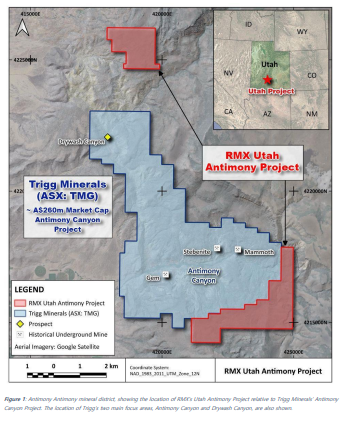
In September, Red Mountain announced the acquisition of 87 claims within the Antimony Mining district east of the town of Antimony, Utah, USA11. The Antimony Mining district was discovered in 1879 and produced high-grade Sb ores from multiple small-scale mines from 1880 to about 1908 and intermittently into the 1960s. RMX’s claims lie immediately along strike to the north and south of Trigg Minerals’ (ASX: TMG) Antimony Canyon Project (Figure 1), which includes more than 30 small historical mine workings surrounding both Antimony Canyon and Drywash Canyon, approximately 6km north of the main prospect.
Antimony Mining District – Antimony Mineralisation
Antimony mineralisation within the Antimony Mining district is related to an approximately northsouth trending fault system, which is interpreted to represent fault splays related to the Paunsaugunt Fault. These faults are thought to have provided pathways for hydrothermal fluids from nearby volcanic centres to migrate upward towards favourable stratigraphic horizons, where antimony typically occurs as stibnite veins and stockwork zones sub-parallel to flat-lying stratigraphy. The dominant host for mineralisation at Antimony Canyon and Drywash Canyon is the Early Palaeocene Flagstaff Formation, which comprises carbonate-rich fluvial sandstone and conglomerate, with TMG’s recent exploration12 concluding that a brittle felsic volcaniclastic horizon within the Formation is the most prospective host unit, but that mineralisation is present at multiple stratigraphic levels, implying potential for both laterally and vertically extensive mineralisation. Channel sampling within and adjacent to historical workings by TMG at Antimony Canyon and Drywash Canyon delivered multiple samples with antimony contents in excess of 10% Sb and a best result of 1.5m at 33.2% Sb from the Stebenite Mine in Antimony Canyon13.
Antimony Canyon and Drywash Canyon represent two eroded windows into the Flagstaff Formation through a thin (interpreted to be mostly <20m thick), but laterally extensive blanket of Quarternary alluvial and colluvial sedimentary cover (Figure 1). However, north-south trending faults that provide fluid conduits for antimony-rich mineralising fluids and the Flagstaff Formation host stratigraphy are interpreted to extend beneath the Quaternary cover and into RMX’s tenements. RMX therefore believes that our Utah Antimony Project has high potential for discovery similar mineralisation to that seen at Antimony Canyon and Drywash Canyon
Red Mountain Yellow Pine Antimony Project, Idaho, USA
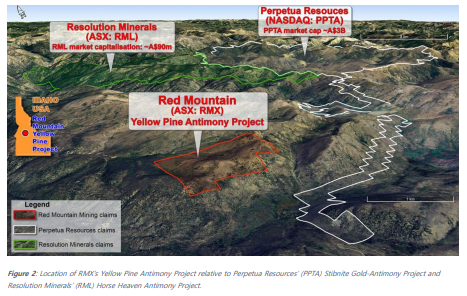
In September, Red Mountain announced the acquisition of 29 claims, less than 2km southwest of Perpetua Resources’ (Nasdaq: PPTA; TSX: PPTA) Stibnite Gold-Antimony Project in central Idaho, USA14.
RMX’s Yellow Pine Antimony Project (Figure 2) is located within the Stibnite Mining District, which was a major source of antimony in the first half of the 20th Century. Recorded production from the Yellow Pine and Hangar Flats deposits between 1932 and 1952 totalled 39,930 tonnes of Antimony15.
These two deposits and the West End Deposit, which produced gold and silver from 1978 to 1997, collectively comprise the Proven and Probable Reserve of 104 Mt @ 1.33g/t Au and 0.06% Sb for 4.8Moz Au and 148Mlbs Sb for Perpetua’s Stibnite Project16, which is the largest known antimony deposit in the USA. The rich endowment and exploration potential of the Stibnite District has also been recognised by Resolution Minerals (ASX: RML), whose Horse Heaven Antimony Project lies immediately west of Perpetua’s claims and approximately 5km north of RMX’s project area.
Antimony-gold-tungsten mineralisation in the Stibnite Mineral District
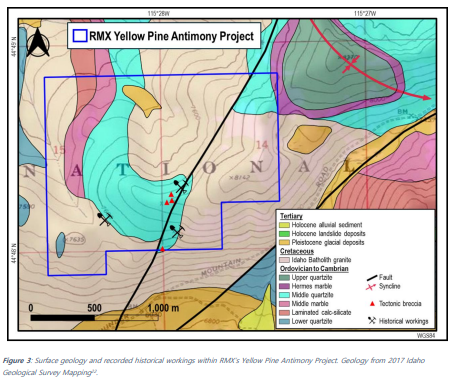
Antimony-gold-tungsten mineralisation in the Stibnite Mining District is structurally controlled along early Tertiary north-south striking regional scale faults and smaller northeast-striking splays and is hosted in the Cretaceous granitoids of the Idaho Batholith and adjacent Neoproterozoic to Paleozoic metasedimentary roof pendant rocks (Gillerman et al., 199217).
2017 geological mapping by the Idaho Geological Survey18 shows that RMX’s claims feature similar prospective geology to that seen within the Perpetua Resources’ Stibnite Project area, with folded Ordovician to Cambrian metasediments intruded by Idaho Batholith granite and cut by a major NNEtrending Tertiary fault, with associated tectonic brecciation and evidence of historical small-scale mining activity (Figure 3)
Red Mountain Silver Dollar Antimony Project, Idaho, USA
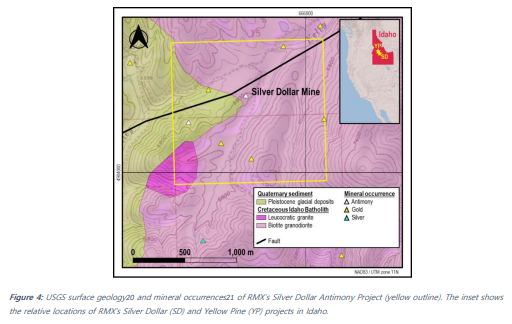
In October, Red Mountain announced the acquisition of a further claims in central Idaho, covering 2km2 with demonstrated historical antimony production19. The Silver Dollar Antimony Project lies approximately 75km southeast of both RMX’s Yellow Pine Antimony Project, and Perpetua Resources’ Stibnite Gold-Antimony Project.
RMX’s Silver Dollar claims encompass four known alluvial gold and two antimony mineral occurrences, including the Silver Dollar Mine (Figure 4), which features a 10m deep shaft sunk into fractured granodiorite in 1944, targeting a massive stibnite vein up to 1m thick.
Red Mountain Armidale Antimony-Gold Project, New South Wales, Australia
During 2025, Red Mountain has demonstrated high-grade orogenic antimony mineralisation with associated gold at multiple prospects within the Company’s Armidale Antimony-Gold Project (EL9732) in the Southern New England Orogen (SNEO) of northeast New South Wales, by demonstrating high-grade orogenic antimony mineralisation with associated gold at multiple prospects
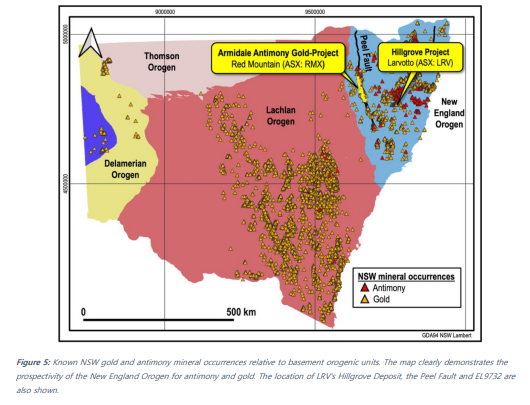
The SNEO is widely recognised as Australia’s premier antimony province, with 250 antimony mineral occurrences identified in the Geological Survey of NSW mineral occurrence database (Figure 5).
Antimony occurs in hydrothermal quartz veins, breccias and stockworks, often with associated gold and/or tungsten mineralisation.
Red Mountain continues aggressive acquisition strategy
Red Mountain continues to aggressively seek further opportunities to expand its portfolio of highquality antimony projects in Tier 1 US mining jurisdictions, with a goal of building a portfolio of assets to leverage what is an unprecedented critical shortage of Western supply of the metal. Subject to the satisfactory completion of due diligence, the Company expects to announce further highly prospective acquisition/s in the near term.
Full ASX Announcement: https://hotcopper.com.au/threads/ann-rmxff-set-to-commence-trading-on-us-stock-exchange.8867707/