

Red Mountain Mining Ltd (ASX:RMX) Satellite Data Targets Key Antimony Highlights at Armidale
19 August 2025
Price Sensitive Announcement $
Highlights:
Processing and interpretation of Sentinel 2 multispectral satellite data over RMX’s
Armidale Antimony-Gold project in NSW has identified an extensive series of
spectral signatures for Stibnite (Antimony Sulfide) mineralisation and Jarosite,
which is associated with weathering of sulfides
• The spectral occurrences show a strong spatial correlation with the Peel Fault
system, as would be expected for structurally-controlled vein-style antimony mineralisation and highlight new areas for ground follow up, particularly along the Namoi Fault and in the northern portion of EL9732
• Horsley Station gold and East Hills Antimony prospect both highlighted in report
• Oaky Creek shows an elevated helium response, which may indicate an underlying granitic source for the stibnite mineralisation seen at surface
• RMX’s exploration team has commenced the second phase of the exploration program at the Armidale project, with target areas featuring in the satellite report
Overview:
Red Mountain Mining Limited announces positive results from a multispectral remote sensing study using Sentinel-2 visible/near infrared (VNIR) and shortwave infrared (SWIR) satellite imagery, which was completed by consultants Dirt Exploration (“Dirt”) to generate possible Antimony targets along the Company’s Armidale Antimony-Gold Project, EL9732 covering parts of the Peel Fault and Namoi and Cobbadah splays. Dirt’s processing of the imagery identified multiple possible stibnite occurrences as well as secondary weathering products, particularly jarosite and possible evidence of parental source magmas with circular helium gas signatures. This dataset will be integrated with other available geochemical, geological and geophysical datasets to generate follow-up targets.
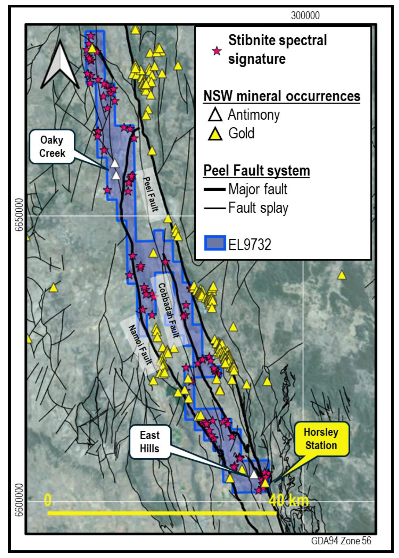
Unmixing of the spectral data identified stibnite adsorption spectra along the length of the tenement. One hundred of these features have been identified, with an apparent structural control, as many of the stibnite occurrences occur along or subparallel to the mapped Peel Fault System (Figure 1). RMX’s priority Horsely Station gold target is highlighted by the stibnite spectra. The dataset also highlights several other targets for
ground follow-up, most notably along the length of the Namoi Fault and the throughout the northern end of EL9732, where minor historical alluvial gold mining has occurred, but no antimony mineralisation is recorded.
Dr Neil Pendock of Dirt Exploration commented on the findings:
“The targets make geological sense and are easy to verify via fieldwork. It is satisfying to see an enigmatic area receive attention from advanced exploration tools such as satellite remote sensing and data analysis tools from AI that are transforming exploration.”

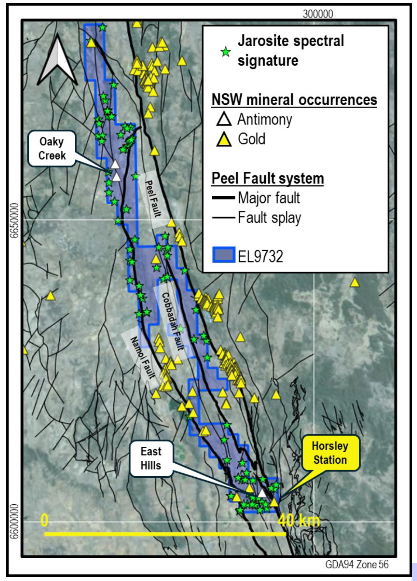
In addition to the stibnite spectra, jarosite was also unmixed by Dirt from the spectral dataset, as the two can co-exist where the antimony sulfide (stibnite) is oxidised. Jarosite is a potassium iron sulfate hydroxide that forms in acidic environments and is known to scavenge metallic elements, including antimony and arsenic. Jarosite was observed by RMX geologists during rock and soil sampling at Oaky Creek (RMX ASX Announcement 30/5/2025), where it was associated with oxidation of primary stibnite mineralisation, along with cervantite, stibicontite, senarmonite and valentinite.
The distribution of jarosite from the spectral data is shown in Figure 2. As was seen for stibnite, there is a strong apparent structural control on its distribution related to the Peel fault system. The Horsley Station and East Hills prospects show a strong response while Oaky Creek again shows no response. In the northern half of EL9732 the majority of jarosite spectral occurrences are spatially related to the Namoi Fault and its splays.
Figure 2: Location of jarosite spectral occurrences within EL9732 relative to the Peel Fault system as mapped by Geological Survey of NSW and known gold and antimony mineral occurrences from the GSNSW database. The major Peel, Cobbadah and Namoi Faults are labelled as well as RMX’s priority Oaky Creek, East Hills and Horsley Station prospects.

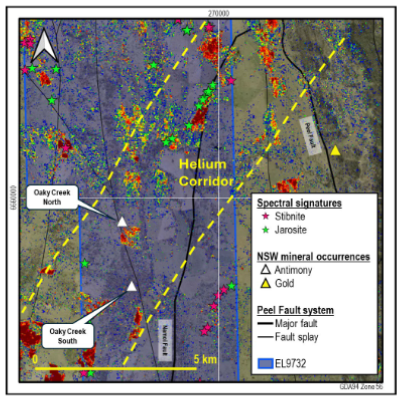
The satellite data were also processed by Dirt for the spectral signatures of helium, carbon dioxide, methane and radon. Areas of elevated helium can be generated by the decay of radioactive elements in concealed granites. The processing defined a NNE-SSW trending corridor of elevated helium running through the Oaky Creek prospect, which may indicate an underlying granitic source for the stibnite mineralisation seen at surface.
Next Steps
RMX will secure land access to ground truth the newly-identified stibnite and jarosite spectral anomalies, in particular those are lie adjacent to known mineralisation and/or are along the known major structures, the Peel, Namoi and Cobbadah faults.
As previously reported (RMX ASX Announcement 11/7/2025), soil and rock chip sampling has commenced with Red Mountain’s geological team working on Oaky Creek, East Hills and Horsley Station, all of which feature prominently in the findings of the satellite data report.
Full ASX Announcement: https://investorhub.redmountainmining.com.au/announcements/7111098