

Red Mountain Mining Ltd (ASX:RMX) Identifies Several High-Grade Antimony Soil Anomalies at Armidale
11 June 2025
Price Sensitive Announcement $
Highlights:
- Highly Anomalous Antimony-in-Soil results reveal new target zones beyond known
source areas at both Oaky Creek North and Oaky Creek South - Two New Highly Anomalous areas defined, with assays up to 333ppm Sb in soil
- New Northern Antimony area is potentially a strike extension of Oaky Creek North,
~1km south-east away from the historic pits - A newly defined Antimony soil trend north of Oaky Creek South also confirms a
previously undiscovered trend - High Gold-in-soil assay result lies in the New Northern Antimony area
- Rock Chip assay results are anticipated to be received by the end of next week
Overview:
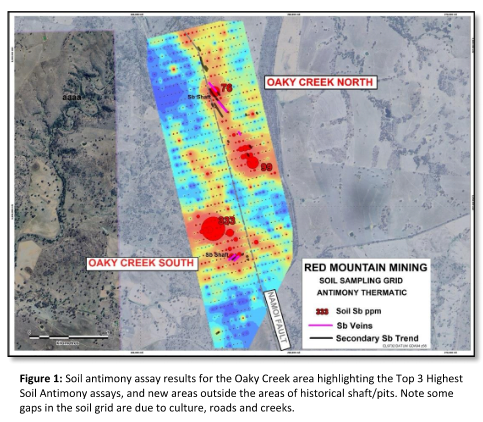
Red Mountain Mining Limited has reported that Highly Anomalous Antimony soil assays have been confirmed at Oaky Creek, part of RMX’s 100% owned Armidale Antimony-Gold Project. A newly defined south-east trend away from the Oaky Creek North pits has been revealed, additionally a new area near Oaky Creek South has opened where up to 333pm Sb in soil has been discovered. The distribution of Antimony in the soils suggests a network across Oaky Creek, of multiple veins existing over 2.3km along the Namoi Fault and up to 400m from the fault. The supporting rock chip assays are pending and expected to be received by the end of next week.
Red Mountain Widens Antimony Mineralisation at Oaky Creek
Red Mountain has discovered a new anomalous antimony target zone, which includes a spot high of 333ppm Sb and located 400m to the north of the Oaky Creek South pits. This new area represents a possible ENE strike similar to the trend at Oaky Creek South.
At Oaky Creek North distribution of antimony suggests a south easterly extension of around 1km with a strong response towards the end of the extension. The area in between is cropped and cultivation may have subdued the surface geochemical response. Local reports indicate historical pits were infilled, and displaced rock piles contained visible stibnite, identified by the onsite geologist (ASX Announcement 30 May 2025).
Antimony-in-soil anomalies also validate the mineralisation at both the historic Oaky Creek North and Oaky Creek South pits, where coarse stibnite was previously extracted by hand from the shafts/pits (Figure 1).
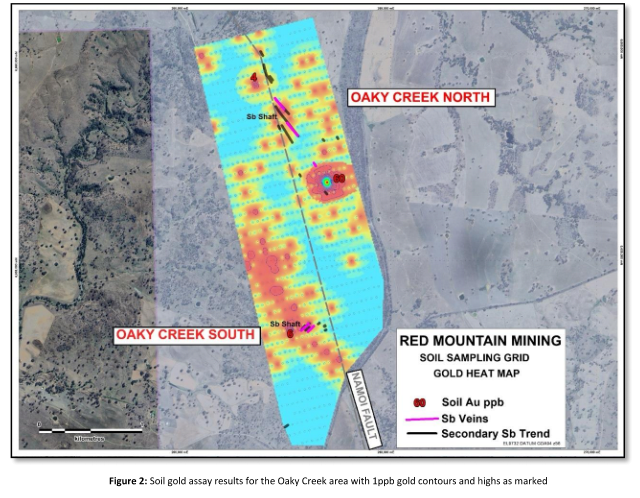
Red Mountain analysed the soils for gold in the Aqua regia multielement suite, although not as sensitive as a Fire Assay technique, encouragingly gold was reported in several areas (refer to Figure 2 for the Gold Heat map). The high gold-in-soil sample lies on strike to the north of the 99ppm Sb soil sample on the Oaky Creek North trend. At Oaky Creek South, gold-in-soil was located just west of the old workings.
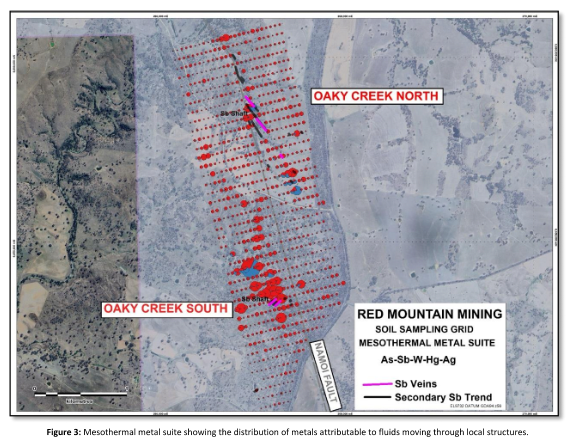
The Mesothermal metal suite reported in this part of the Southern New England Orogen is typified by Au- Sb-As-Ag-Hg-W association with fluids rich precipitating in ore shoots and shear zones. The thematic map of the distribution of the metals is shown in Figure 3, except for Au. Arsenic has an association with Antimony and is more widely spread than the Antimony but may be delineating potential extensions to the stibnite vein system. Soil Assays are presented in Appendix 1.
Background
Ground sampling rock chip sampling in the Oaky Creek area (ASX Announcement 30 May 2025) identified coarse-grained stibnite mineralisation within quartz vein-hosted structures, the recent soil assay results support some of these areas. Interpretation and mapping by Red Mountain’s geological team indicate multiple parallel stibnite vein systems, with structures at Oaky Creek North trending northwest and those at Oaky Creek South trending northeast. The Oaky Creek North alteration system appears to have an inferred strike length over 1km, which the company will confirm by rock assay results. Red Mountain interprets that the possible change of orientation between the north and south is due to movement along Namoi Fault, that cuts through the grid with Oaky Creek North residing to the east of the fault and Oaky Creek South residing to the west of the fault.
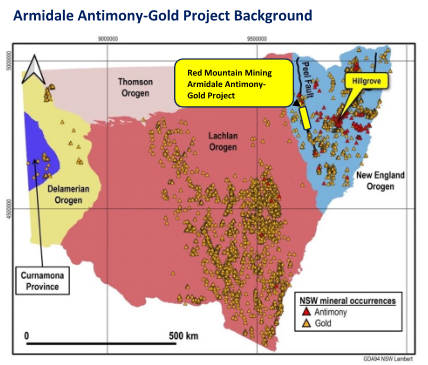

Red Mountain’s project lies approximately 100km west of Larvotto’s (ASX: LRV) Hillgrove Project and several of Trigg Minerals’ (ASX: TMG) Antimony Projects and extends for 85km immediately west of the Peel Fault.
The Southern New England Orogen is recognised as Australia’s premier Antimony province (Figure 4). Antimony occurs in hydrothermal quartz veins, breccias and stockworks, often with associated gold and/or tungsten mineralisation.
The geology of the tenement is dominated by isoclinally folded Carboniferous metasediments of the Tamworth Belt, which is a forearc basinal package related to west-dipping subduction of oceanic crust beneath the Lachlan Orogen. Ultramafic melanges of the Great Serpentinite Belt, which outcrop along the Peel Fault, are considered to be remnants of this oceanic crust. The Peel Fault System has recognised world- class mineral potential, with over 400 known orogenic gold and base metal mineral occurrences along its over 400km strike extent but is underexplored with less than 200 mostly shallow drillholes over its length, the majority of which are focused on discrete prospects.
Full ASX Announcement: