

Red Mountain Mining Ltd (ASX:RMX) Gold Lode Confirmed and Further Gold Nuggets Discovered at Kiabye
Highlights
- Initial gold assays from RC drilling confirm the presence of structurally controlled auriferous quartz veining in multiple holes at Kiabye South, with a best result of 2.92 g/t Au over 1m
- Drilling at Kiabye North intersected quartz veining associated with magnetite, with trace gold detected
- Gold Nuggets discovered from a new area at Prospectors Patch in the southeast of RMX’s project
- Nearby gossanous quartz breccias represent potential sources for the alluvial gold and will be systematically sampled along with other outcropping material to understand the origin of the gold
Overview:
Red Mountain Mining Limited has reported initial assay results from sampling of nine slimline RC drillholes, totaling 993m at the Company’s 100%-owned Kiabye Gold Project in the Murchison Province of Western Australia. The most promising results were returned from the Kiabye South prospect, where drilling targeting a ~N-S trending magnetic linear with elevated Au in soils returned a best result of 2.92g/t Au over 1m.
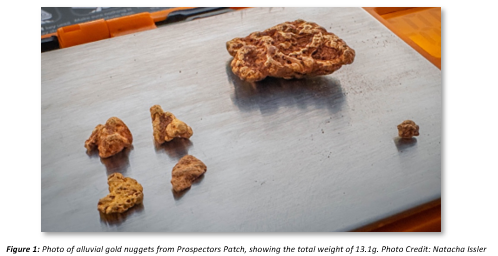
Following on from the discovery of eleven gold nuggets in the Reef 1 area in the north of the Kiabye project (RMX ASX Announcement 23/6/2025), a further six alluvial gold nuggets (Figure 1), with the largest weighing 10g, were discovered by RMX’s geology team over the Prosectors Patch area in RMX’s southeast licence.
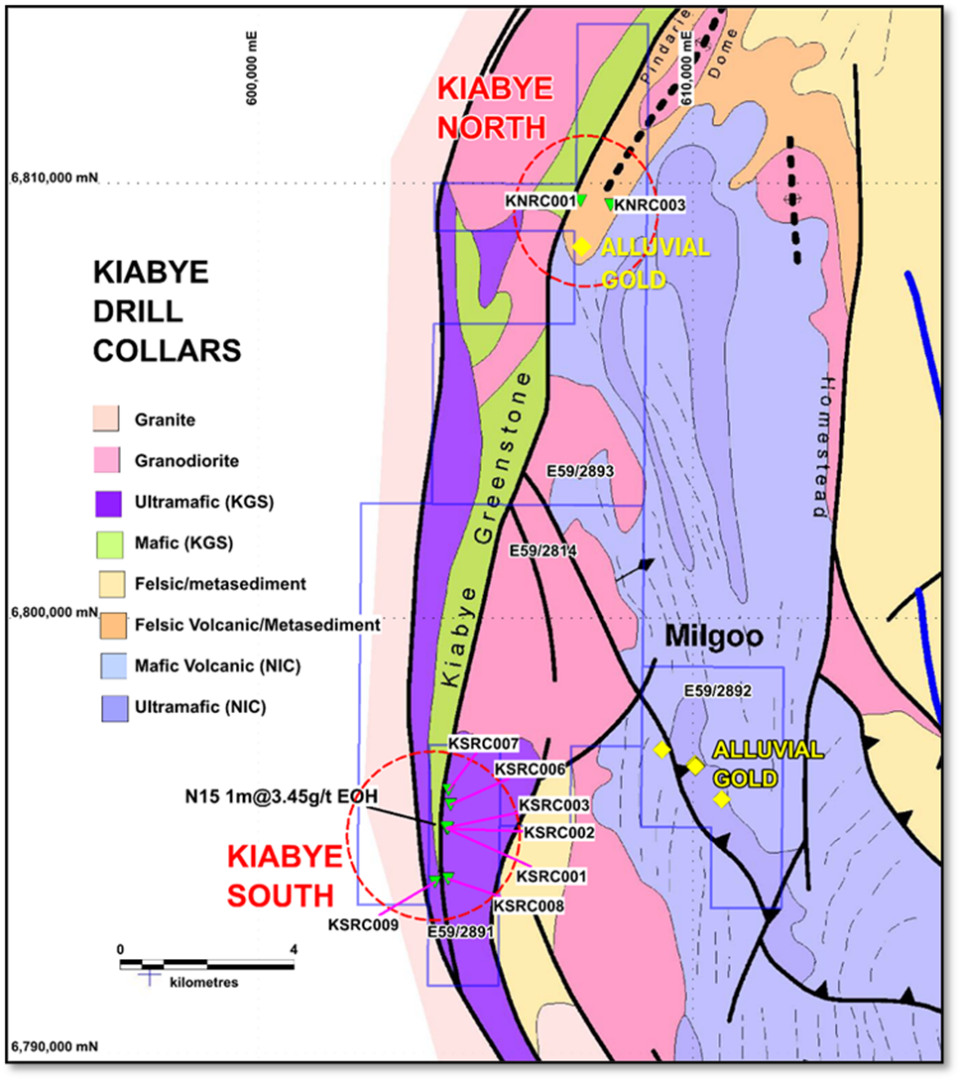
At the Company’s southeast licence (EL59/2892) where the new discovery was made, multiple outcrops of ferruginous and gossanous quartz breccia are exposed near a major NW-SE thrust fault within the basal units of the Narndee Igneous Complex layered intrusion (Figure 2).
Initial results from Kiabye RC drilling uncovers highly encouraging gold grades
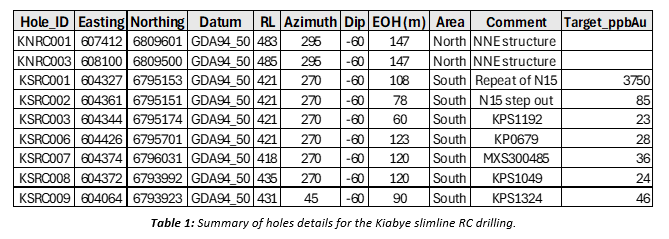
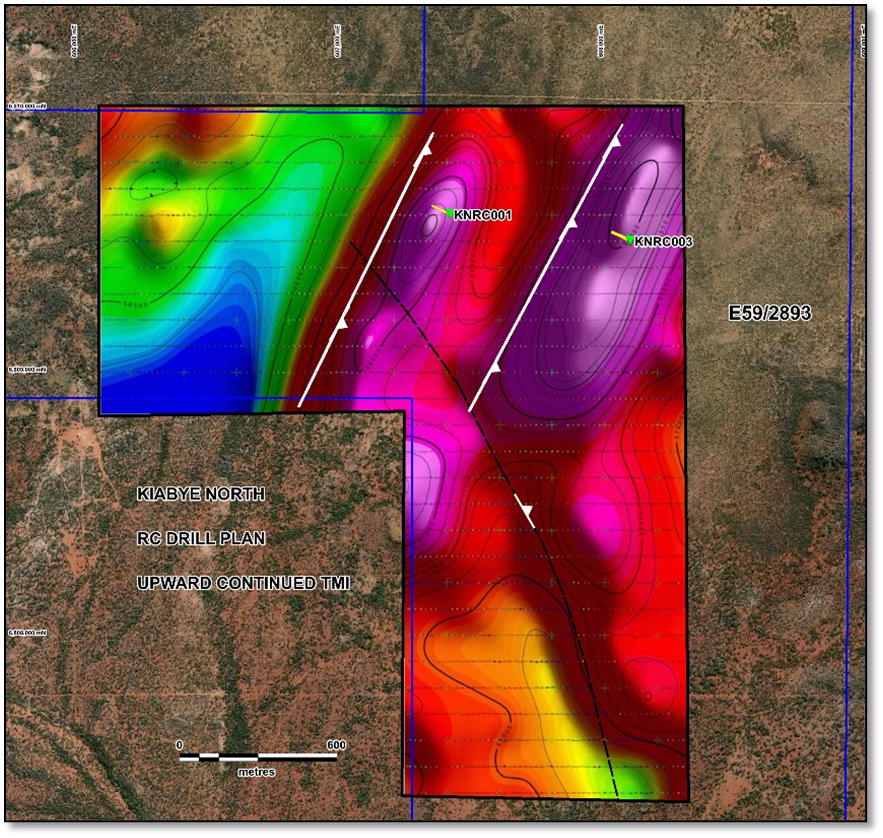
Red Mountain completed a nine-hole slim-line RC drilling program, totaling 993m, over the Northern and Southern targets at the Kiabye Gold Project. Drillhole details are summarised in Table 1 and locations shown in Figures 2 to 4. Selected quartz-bearing intervals were sampled for gold analysis by Lead Fire Assay (50g FAA).
Summary drill logs and gold assays are provided in Appendix 1. The highly encouraging results were returned from the drilling at Kiabye South, with three of the seven holes drilled there intersecting anomalous (> 0.1 g/t Au) gold associated with quartz veining:
- KSRC001: [email protected]/t Au from 15m.
- KSRC002: [email protected]/t Au from 50m, including [email protected]/t Au from 51m.
- KSRC007: [email protected]/t Au from 19m.
Kiabye North
Interpretation of high-resolution ground magnetic data at Kiabye North (RMX ASX Announcement 28/4/2025) identified two prominent NE trending linear magnetic anomalies (Figure 3). These anomalies were interpreted to correlate with southeasterly dipping magnetite-bearing quartz vein systems, a key structural control for gold mineralisation in the region and targeted for drill testing. In hole KNRC001 drilling intersected multiple thin magnetite-bearing zones with magnetic susceptibility up to 651 x10-3SI with minor associated quartz-epidote veining (Appendix 1). In the second hole, KNRC003, drilling intersected a thick 42m magnetite-bearing zone, averaging 88×10-3SI, with minor quartz carbonatite veining (Appendix 1). The thicker quartz veins in both holes were assayed, but only reported trace gold, with a maximum value of 4ppb Au.


Kiabye South
Red Mountain has previously completed a rock chip and 25m-spaced soil sampling program at Kiabye South, across the central portion of the Kiabye Greenstone Belt along a 2,500m long North-South linear magnetic linear target. The soil results identified several discrete gold-in-soil anomalies along the N-S magnetic feature, which is interpreted to represent a demagnetised zone associated with an interpreted shear/fault zone, with the anomalous gold representing mineralised leakage points along the structure (RMX ASX Announcement 14/11/2024).
Historical shallow RAB drilling of the linear target also returned a result of 1m @ 3.45 g/t Au from 14m in the last metre of hole N15, which is located close to a surface rock sample containing 0.728 g/t Au (ASX Announcement 5 August 2024). Seven drill holes were completed at Kiabye South (Figure 4), with six of these designed to test the historical RAB result and gold in soil anomalies along the magnetic lineament and the seventh, KSRC009, targeted at a gossan sample (KPR065) collected by RMX in 2024, which assayed 1.12% Ni, 0.95% Co and 0.07% Cu (RMX ASX Announcement 14/11/2024).
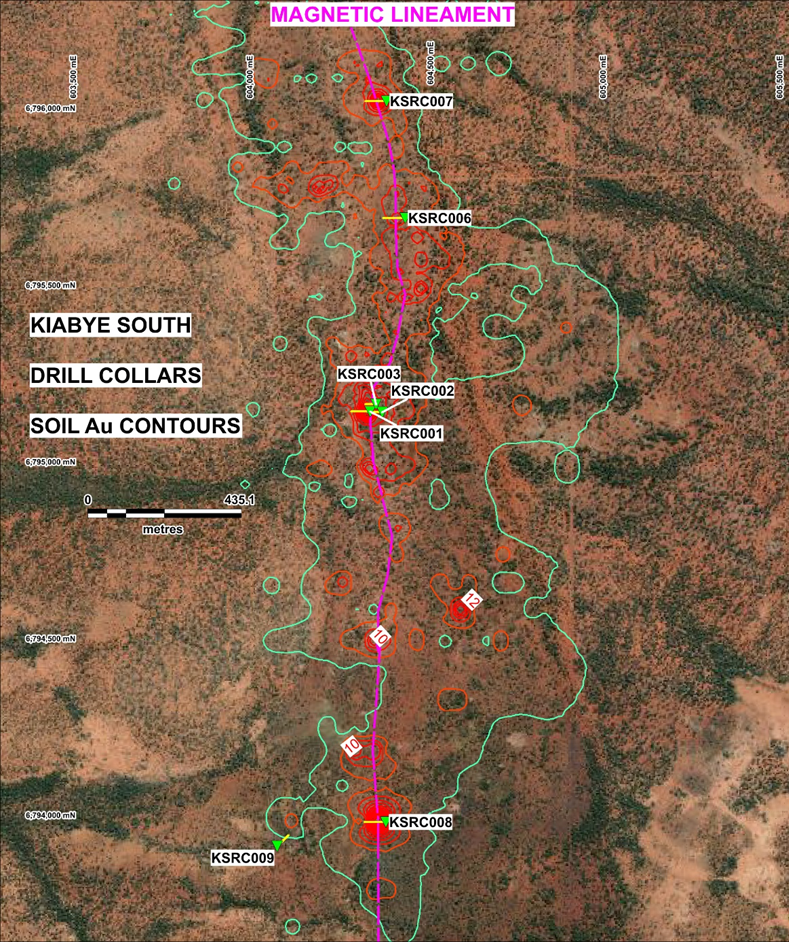

Two of the three holes drilled to test the historical anomalous RAB result, KSRC001 ([email protected]/t Au from 15m) and KSRC002 ([email protected]/t Au from 50m, including [email protected]/t Au from 51m), returned intersections of >0.1g/t Au, providing encouragement for further work on this anomaly. The sole drillhole into the northernmost soil anomaly along the magnetic lineament, KSRC007, returned the highest gold result of [email protected]/t Au from 19m, which will also be followed up by additional drilling to better understand the extent of the mineralisation.