

Red Mountain Mining Ltd (ASX:RMX) Acquires Historical Antimony-Gold Mine in Idaho
7 October 205
Price Sensitive Announcement $
Overview:
- RMX has acquired the highly prospective “Silver Dollar Antimony Project” in Idaho, USA, increasing RMX’s footprint in the Idaho area by over 80%
- The historical Silver Dollar Mine lies within RMX’s claims. Historical production from the 1940s has estimated average ore grades of 17.7% and the USGS mineral database records a grade of 14.6% Sb and 6.3ppm Ag from a stockpile sample from the mine
- Red Mountain’s Silver Dollar Antimony Project lies southeast of the Company’s Yellow Pine Antimony Project and features multiple antimony and gold mineral occurrences, including a 10m deep shaft sunk into fractured granodiorite in 1944, targeting a massive stibnite vein up to 1m thick
- The stibnite vein mineralisation is related to an ENE-striking, steeply N-dipping fault and the granodiorite host is part of the Cretaceous Idaho Batholith, which is an analogous geological setting to Perpetua Resources’ (Nasdaq: PPTA) Stibnite Gold-Antimony Project,
which has a Proven and Probable mineral reserve of 4.8Moz Au and 148 Mlbs Sb - The addition of the Silver Dollar Antimony project provides RMX increased scale in the central Idaho region and its North American Antimony-Gold portfolio
- RMX’s US based technical team identified and secured the project, further advancing the Company’s strategy of acquiring highly prospective projects utilising internal resources, thereby increasing expertise and knowledge in the US critical metals space with the intention of significantly increasing shareholder value, without the cost of external vendors
- The Company believes achieving scale will be a significant long-term competitive advantage in the US Critical Metals sector and continues to assess additional high potential opportunities
- Following its recent capital raising, RMX is well-funded to aggressively execute exploration across its portfolio and assess new venture opportunities
Overview:
Red Mountain Mining Limited announced that it has acquired a further 24 claims in central Idaho, with demonstrated potential to host economic antimony mineralisation. The Silver Dollar Antimony Project lies approximately 70km southeast of both RMX’s recently acquired Yellow Pine Antimony Project, announced on 25 September 20251 , and Perpetua Resources’ (Nasdaq: PPTA / TSX: PPTA) Stibnite Gold-Antimony Project, which is the largest known antimony deposit in the USA, with a Proven and Probable Reserve of 104 Mt @ 1.33g/t Au and 0.06% Sb for 4.8Moz Au and 148Mlbs Sb2 . ASX listed Resolution Minerals’ (ASX: RML) flagship project also lies in the Stibnite District of Idaho.
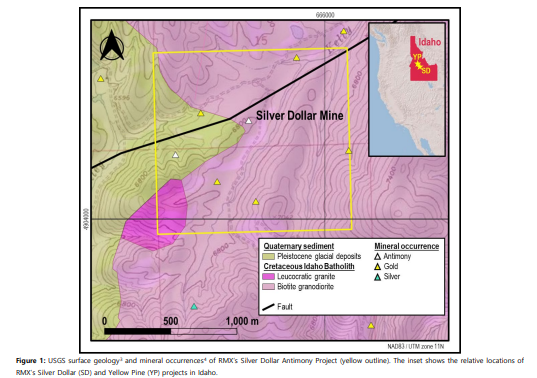
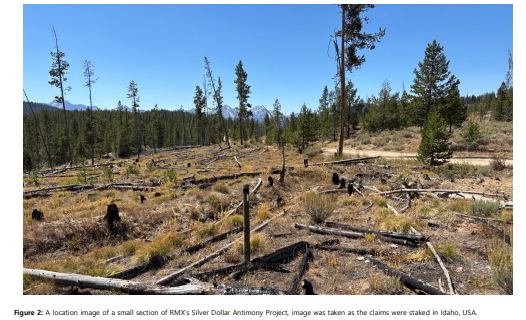
RMX’s Silver Dollar claims encompass four known alluvial gold and two antimony mineral occurrences, including the Silver Dollar Mine (Figure 1), which features a 10m deep shaft sunk into fractured granodiorite in 1944, targeting a massive stibnite vein up to 1m thick.
Antimony mineralisation at Silver Dollar
The most recent published description of the antimony mineralisation at Silver Dollar is included in Choate (1962)5 , who notes that the stibnite vein mineralisation at the Silver Dollar Mine, as well as that seen at the second, unnamed antimony mineral occurrence shown on Figure 1, is spatially related and thought to be genetically linked to an ENE-striking, steeply N-dipping fault. The granodiorite host at Silver Dollar is part of the Cretaceous Idaho Batholith, which is the same intrusive suite that hosts Perpetua Resources’ Stibnite Project, where mineralisation is also structurally controlled, along early Tertiary north-south striking regional scale faults and smaller northeast-striking splays.
Choate (1962) spoke directly with Arthur McGowan, who sunk the shaft at Silver Dollar in 1944, who advised him that the vein he mined comprised a pure stibnite core with quartz gangue only at the margins. He communicated that the near-vertical, steeply north-dipping vein was “paper-thin” at surface, but at 25 feet (7.5m) depth it had swelled to a width of three feet (~1m) and that pieces of pure stibnite up to 45 pounds (20kg) in weight were removed during mining. Choate (1962) states that McGowan received $US56 per ton of ore shipped, which at a fixed US price of 15.84c per pound in 1944-19456, equates to a grade of 354lbs/ton, or 17.7% Sb. This value is consistent with the value of 14.6% Sb and 0.2oz/ton (6.3ppm) Ag cited by the USGS for a stockpile sample from the Mine7.
Choate (1962) concluded that there was significant untested potential remaining for additional antimony, gold, silver, uranium and possibly mercury mineralisation, which is likely to occur as pods or shoots where secondary structures intersect each other and the main NNE-striking fault that cuts RMX’s Silver Dollar claims. There has been extremely limited exploration over the prospect since.
Silver Dollar Antimony Project Exploration Program
Red Mountain’s initial exploration program at Silver Dollar will focus on mapping and sampling where appropriate the main ENE-trending fault through the project area, to locate evidence of intersecting secondary structures, hydrothermal fluid flow, brecciation, alteration and antimony mineralisation, which will then be targeted for drill testing, where justified.
Full ASX Announcement: https://hotcopper.com.au/threads/ann-historical-antimony-gold-mine-acquired-in-idaho.8811301/