
Red Mountain Mining Ltd (ASX:RMX) Acquires High-Grade Antimony Project up to 36.5% Sb Adjacent to America’s only Antimony Smelter
5 February
Price Sensitive Announcement $
Highlights:
• Thompson Falls Antimony Project acquired adjacent to United States Antimony Corporation’s Project (NYSE: UAMY, Market Cap A$2.2b), which operates the only Antimony smelter in the United States, with a crucial role in the US Critical Minerals supply chain
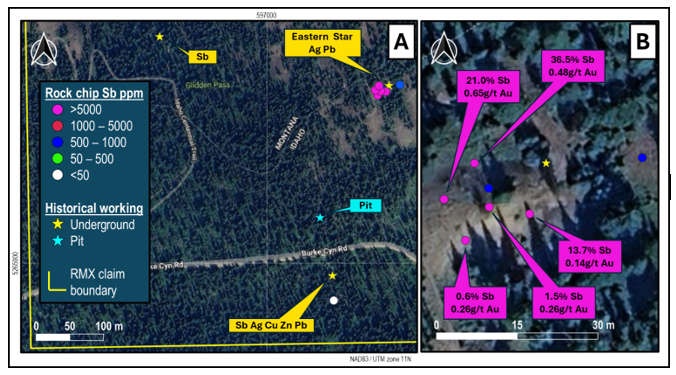
• Red Mountain has immediately identified standout prospectivity at the project, locating three historical underground mines and a pit within the project area. Initial assays from the Thompson Falls Antimony Project have returned superb high-grade results including:
o 36.5% Sb and 0.48g/t Au
o 21.0% Sb and 0.65g/t Au
o 13.7% Sb and 0.14g/t Au
• The Project is located on the Montana-Idaho border, within the same host stratigraphy and near UAMY’s Stibnite Hill Mine, the second largest known stibnite vein deposit in the US, where high grade antimony mineralisation has been mined since 1884. UAMY restarted operations in late 2025 in response to the severe supply shortage in the United States
• The Project is also highly prospective for Silver as it lies at the eastern end of Idaho’s Coeur d’Alene mineral district, which has accounted for ~18% of the USA’s total accumulated silver production, of over 1.25 billion ounces of silver between 1884 and 2020, along with 7.8Mt Pb, 3.0Mt Zn, 1.1Moz Au, 191kt Cu and over 160kt Sb
• Thompson Falls Antimony Project further strengthens Red Mountain’s Utah, Idaho and NSW Critical Minerals portfolio, creating a unique Western asset base positioned to benefit from unprecedented US and Australian government support as both nations seek to secure supply
• The US Government this week launched a $12 billion strategic minerals stockpile initiative, aimed at securing Critical Mineral supply chains. Red Mountain’s Thompson Falls Antimony Project, located 4.2km from UAMY’s operations, is well positioned in Antimony and Silver – both federally designated Critical Minerals aligned with US supply chain priorities
• Red Mountain continues to accelerate its Critical Minerals exploration and development at the Armidale project in NSW, Australia and additional technical work is progressing at the Company’s Utah and Idaho projects.
Overview:
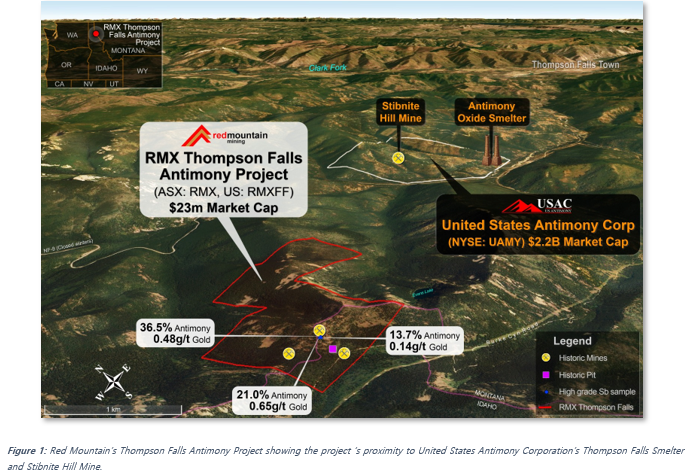
Red Mountain Mining Limited a Critical Minerals exploration and development company with an established portfolio in Tier-1 Mining Districts in the United States and Australia, has announced the Company’s newly-acquired Thompson Falls Antimony Project, (Figure 1), located 4.2km from United States Antimony Corporation’s operations (NYSE: UAMY; Market Cap A$2.2 billion) with the only operating Antimony smelter in the US – the Thompson Falls Smelter in Montana and the Stibnite Hill Mine. Red Mountain’s initial batch of assay results have returned outstanding grades of up to 36.5% Antimony and 0.65g/t Gold at the Thompson Falls Antimony Project. The project was acquired utilising internal cash from the December funding initiative. The project sits on the border of Montana and Idaho and situated within the same host stratigraphy as UAMY’s Stibnite Hill Mine, the second largest known stibnite vein deposit in the US, where high grade antimony mineralisation has been mined since 1884, with UAMY restarting operations in late 2025 in response to rapidly increasing US demand. Red Mountain has commenced field-work which includes geological mapping, sampling potential mineralisation structures and exploration across alteration zones and potential outcrop – with results expected to be received this quarter
High-grade Antimony Immediately Discovered and Several Historic Mines Identified
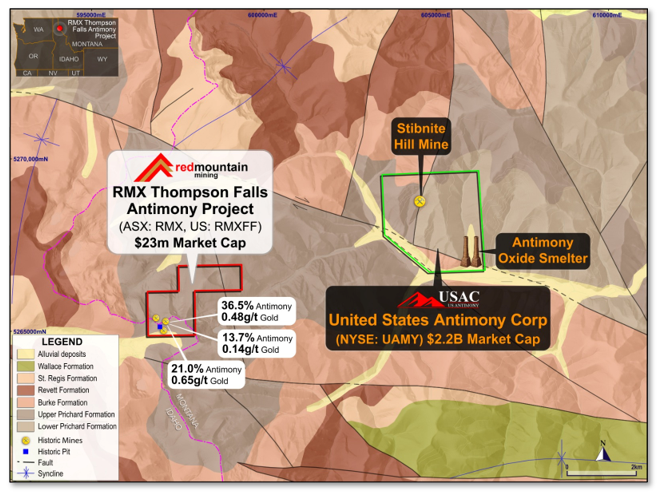
Red Mountain has discovered high-grade Antimony and highly anomalous gold as part of its first-pass program (Figure 5 and Table A) at the Eastern Star underground mine returned high antimony results, up to 36.5% Sb, and elevated gold, up to 0.65g/t Au. These samples also consistently contain elevated arsenic. Red Mountain’s US field team successfully located three historical underground mines and one pit within the Company’s Thompson Falls Antimony Project area (Figure 3; Figure 4).
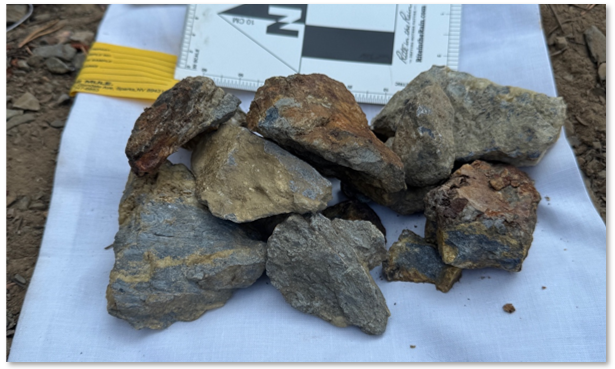

Most of the samples collected by Red Mountain from the Eastern Star mine closely resemble the quartz-stibnite veins mined at UAMY’s Stibnite Hill deposit (discussed below), 6km east of Red Mountain’s Thompson Falls Project area, although these veins are not recorded as producing gold.
However, the wide variety of listed metals for the three mines within the project area and the presence of siderite in some material on the Eastern Star dump (Table A) suggests that the Thompson Falls Project has potential to also host the silver-rich polymetallic vein mineralisation that is typical of the rich Coeur d’Alene mineral district that lies immediate west of Red Mountain’s claims.
The three underground workings are listed in the Idaho Geological Survey and Montana Bureau of Mines and Geology historical mines databases, with their produced metals listed as silver-lead (Eastern Star), antimony, and antimony-silver-copper-zinc-lead, as shown on Figure 3.

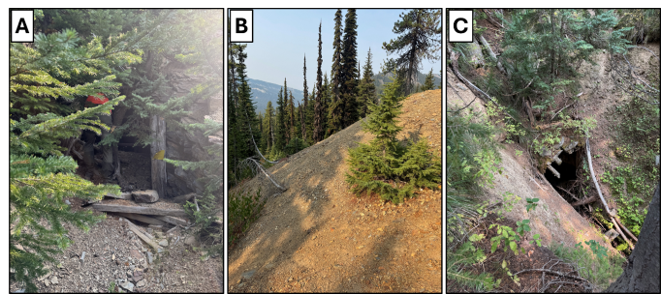

During initial reconnaissance, seven samples were collected from the Eastern Star Ag-Pb mine by Red Mountain’s field crew and one sample was collected from south of the unnamed occurrence with recorded production of Sb-Ag-Cu-Zn-Pb (Figure 4 and 5; Table A).

Project located in a prime position in a globally significant mineralised belt Red Mountain’s Thompson Falls Antimony Project lies at the eastern end of Idaho’s Coeur d’Alene mineral district, which is one of the globe’s largest silver provinces, accounting for ~18% of total accumulated US production, and has also produced significant quantities of lead, zinc, gold, copper and antimony. Recorded metal production for the Coeur d’Alene mineral district between 1884 and 2020[1] totals 1,257Moz Ag, 7.8Mt Pb, 3.0Mt Zn, 1.1Moz Au and 191kt Cu. Production figures for antimony are not readily available and the metal was historically treated a waste product by many producers. Taylor and Hoffstra (2005)[2] estimate that 161kt Sb was produced from the Sunshine Mine, which was also one of the world’s richest and largest silver mines throughout the 20th Century before closing in early 2001. Only a small portion of Sunshine’s antimony production is recorded by the Idaho Geology Survey, who detail production of 5.5kt Sb[1],[2] between 1982 and 2000. Taylor and Hoffstra (2005)4 also note production of an unspecified quantity of antimony from the Bunker Hill – Last Chance and Crescent mines.
As described in Reid (Ed., 1961) [3], polymetallic orogenic vein mineralisation in the Coeur d’Alene mineral district is hosted in Middle Proterzoic (~1,400Ma) low grade metasedimentary rocks of the Belt Supergroup, with most mineralisation hosted in the St. Regis Formation, Upper Revett Formation, Lower Burke Formation and Prichard Formation. Mineralisation occurs as fault-controlled siderite-quartz-sulfide veins, with sulfide mineralogy principally comprising silver-rich tetrahedrite [(Cu,Fe,Zn,Ag)12Sb4S13], galena [PbS], sphalerite [(Zn,Fe)S] and chalcopyrite [CuFeS2]. The mineral veins in the district consist principally of siderite (tan-colored iron carbonate) with quartz and sulfide minerals, principally tetrahedrite (a silver-rich, copper-antimony sulfide), galena (lead sulfide), sphalerite (zinc sulfide), and chalcopyrite (copper-iron sulfide). Veins can range in thickness from a few centimetres to several meters in thickness and can be laterally and vertically extensive, extending along strike over more than a kilometre and extending to depths of up to 1.5km. They typically show little evidence of vertical zonation, but can show lateral changes in sulfide mineralogy.
Orogenic polymetallic vein-hosted mineralisation is known to extend from the Coeur d’Alene mining district into western Montana. Red Mountain’s Thompson Falls Antimony Project encompasses the Upper Prichard Formation, which hosts mineralisation within the Coeur d’Alene mineral district and is also the host for mineralisation at US Antimony’s nearby Stibnite Hill antimony mine (Figure 2).
Next steps for the Thompson Falls Antimony Project
Red Mountain is expecting additional assay results from sampling completed at Thompson Falls, to be received this quarter. The Company plans to undertake further reconnaissance exploration and sampling over the project area to locate any additional undocumented historical mine workings and potential mineralised exposures. The Red Mountain US team also plans to further inspect and access and sample the underground mines already located, to better understand the nature of mineralisation present at these prospects, prior to assessing and finalising plans for drill targets.