Red Mountain Mining (ASX:RMX) Advances its Antimony-Gold Exploration at Armidale
11 July 2025
Price Sensitive Announcement $
Highlights:
- Gold results for 102 rock chip samples from the Oaky Creek Antimony prospect returned values of up to 0.54g/t Au, with all anomalous samples located within the prospective trends defined by the soil Antimony results, consistent with the presence of an orogenic Sb-Au system
- Approximately 2500m of shallow trenching is planned across three separate Antimony soil geochemical anomalies at Oaky Creek, which have no direct association with historical mine workings or outcropping mineralisation
- RMX anticipates that mapping and sampling of the trenches will allow the company to identify multiple targets at Oaky Creek for follow-up drill testing
- Three further priority Antimony and Gold targets to be tested:
- Major >1000 station soil sampling program targeted at the East Hills Antimony prospect and the Horsley Station gold prospect, both of which feature historical mine workings
- New Gold target “Horsley North” featuring a magnetic high to be tested
Overview:
Red Mountain Mining Limited has announced gold assays for 102 rock chip samples and to further detail the Company’s immediate accelerated program at the Armidale Antimony-Gold project. This follows the exceptional support in Red Mountain’s recent funding initiative, anchored by three strategic investors all of whom have positioned as Top 20 shareholders of Larvotto Resources (ASX: LRV).
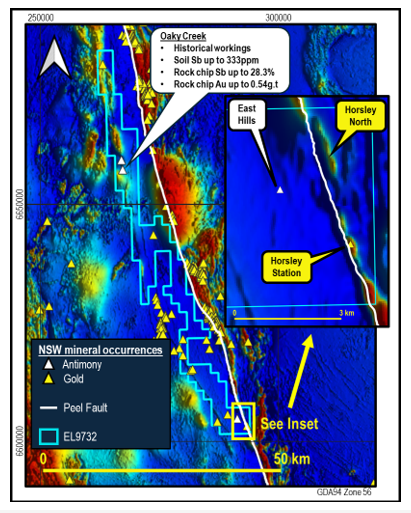
Gold analytical results of up to 0.54g/t Au have been received for rock chip samples from the Oaky Creek prospect in the northern portion of the tenement (Figure 1), where the company recently reported antimony in soils results of up to 333ppm Sb[1] and rock chip values of up to 28.34% Sb[2].
An extensive program of shallow trenching is planned to uncover basement geology beneath three unexplained soil anomalies at Oaky Creek where no outcropping mineralisation was detected. If successful in uncovering mineralisation, the trenching program will confirm the presence of orogenic antimony mineralisation over a strike extent of 1.5km at Oaky Creek North and 800m at Oaky Creek South.
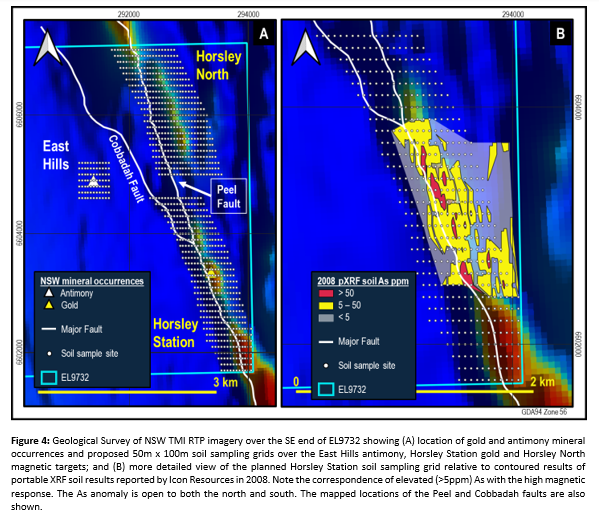
In the south of EL9732 (Figure 1), RMX will collect 1032 soil samples across three 50m x 100m grids designed to test for:
- An extension of the historically mined quartz vein-hosted antimony mineralisation at the East Hills prospect.
- The extent of gold mineralisation at the Horsley Station prospect, where historical workings close to the Peel Fault coincide with a distinct magnetic high, interpreted to be serpentinite mélange, which is an analogous setting to the gold deposits of the Bingara and Teatree goldfields, further to the north.
- Evidence of gold mineralisation associated with a similar magnetic high (termed Horsley North) located approximately 2km north of Horsley Station and extending along the Peel Fault to RMX’s tenement boundary.

Gold rock chip results confirm the presence of an orogenic Antimony-Gold system at Oaky Creek
Following receipt of the strong Antimony rock chip results for Oaky Creek reported on 27 June 2025[1], 102 of these samples were submitted for gold analysis by fire assay with lead collection. The samples were collected from insitu outcropping exposures where possible, but subcrop and float samples were collected where this was not possible. Rock chip sample locations, nature (outcrop, subcrop or float) and geochemical results are provided in Appendix 1.
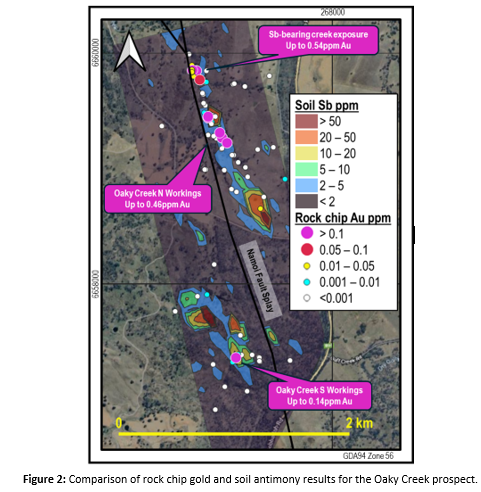
Gold results for the rock chip samples from Oaky Creek are shown in Figure 2. Strongly anomalous (>0.1ppm Au) rock chip results were returned for samples collected from the historical workings at Oaky Creek North (up to 0.46ppm Au) and Oaky Creek South (up to 0.14ppm Au) and from the antimony-bearing creek exposure ~500m NNW of Oaky Creek North (up to 0.54ppm Au), showing good correlation with high antimony results. Similarly, no samples with elevated (>0.01ppm Au) gold were collected outside of the footprint of the two main antimony soil anomalies. This strong spatial correlation between antimony and gold supports RMX’s exploration model for the Oaky Creek prospect, targeting a vein-style orogenic antimony-gold deposit, which is analogous to Larvotto’s (ASX: LRV) Hillgrove project, Australia’s largest antimony deposit.
Shallow 2500m trenching program to be completed at Oaky Creek
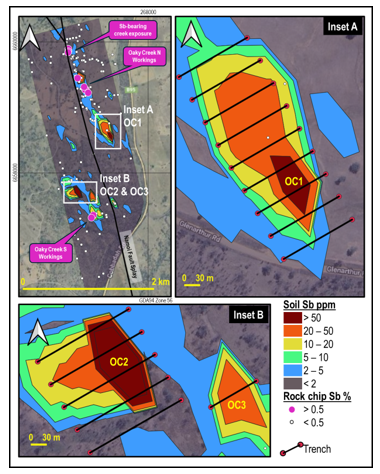
RMX’s soil sampling at Oaky Creek, reported on 7 June 2025[1], defines a ~1.5km long NNW-trending antimony soil anomaly, which extends both north and south of historical workings at Oaky Creek North east of the Namoi Fault splay and a similarly-oriented ~800m antimony soil anomaly that extends north of the Oaky Creek South workings to the west of the fault (Figure 3).
The northern end of the Oaky Creek North anomaly coincides with an antimony-bearing creek exposure that returned rock chip results of up to 28.3% Sb[2] and 0.54ppm Au. However, the strongest portion of the anomaly (termed OC1), ~900 SSE of the Oaky Creek North workings is located in a cleared paddock, with no bedrock exposures observed.
For the Oaky Creek South soil anomaly, strongly anomalous rock chip samples collected close to the historical workings returned values of up to 28.34% Sb5 and 0.14ppm Au. However, no bedrock exposures or float samples were located from within two soil antimony anomalies (termed OC2 and OC3) located 300m to 400m NNW of the workings (Figure 3, Inset B).
To test for bedrock mineralisation beneath OC1, OC2 and OC3, RMX will complete a program of shallow trenching across the three anomalies, comprising 15 trenches oriented at 060⁰, for a total of ~2500m, as shown in Insets A and B of Figure 3. If, as anticipated, the trenches expose orogenic antimony mineralisation beneath the soil anomalies, the program will confirm the presence of orogenic antimony mineralisation over a strike extent of 1.5km at Oaky Creek North and 800m at Oaky Creek South. Any mineralised exposures will be mapped and sampled for geochemical analysis.
The Company has engaged a local earthworks contractor to undertake the trenching work and is currently securing approval from the NSW Resources Regulator for the proposed program of work. RMX anticipates that the work will commence in late July.

Three further priority Antimony and Gold targets to be tested
In addition to Oaky Creek, RMX’s initial assessment of EL9732 identified two further priority exploration targets[1], which like Oaky Creek feature evidence of historical mining, likely dating from the early 1900s (Figure 4A). Neither the East Hills antimony prospect or the Horsley Station gold prospect have been explored systematically, with no soil sampling for gold, antimony or silver previously undertaken at either location.