

Red Mountain Mining (ASX:RMX) Acquires Highly Prospective Antimony Stake in Idaho Complimented by a $1.5m Two Tranche Capital Raising
25 September 2025
Price Sensitive Announcement $
Highlights:
- RMX has acquired the highly prospective “Yellow Pine Antimony Project” in the Stibnite Mining District in Idaho, USA, through staking of claims.
- Red Mountain’s Yellow Pine Antimony Project lies within 2km of Perpetua Resources’ (Nasdaq: PPTA / TSX: PPTA) Stibnite Gold-Antimony Project, which has a Proven and Probable mineral reserve of 4.8Moz Au and 148 Mlbs Sb.
- Perpetua Resources this week has secured final federal clearance to progress construction of its Stibnite Project.
- Mineralisation in the Stibnite District is controlled by regional faults and splays, and occurs within both the Idaho Batholith and surrounding older sedimentary rocks.
- RMX’s Yellow Pine Antimony Project contains all the necessary elements for the formation of economic gold-antimony mineralisation, featuring prospective host rocks, a major northeaststriking fault with mapped tectonic breccias, and evidence of numerous historical workings, most likely seeking gold and/or antimony.
- The Yellow Pine Antimony Project complements RMX’s Utah Antimony Project, announced earlier in the month, and both projects enjoy a strongly supportive government as the Trump administration last month took urgent measures in securing its Critical Minerals supply chains with recent discussions mentioning a potential federal fund of up to US$5 billion of support.
- The project was acquired by Red Mountain’s US based technical team and funded through the Company’s internal financing without third-party vendors.
- Red Mountain successfully closed a heavily oversubscribed $1.5m placement with the Company now well-funded for exploration at the recently acquired Utah Antimony Project and Yellow Pine Antimony Project.
- RMX and its advisors are continuing to explore additional US expansion opportunities, as well assessing a potential US stock market listing to support RMX’s growing Antimony and Critical Minerals portfolio – and given the significant market interest in its projects both in Australia and the USA
Overview:
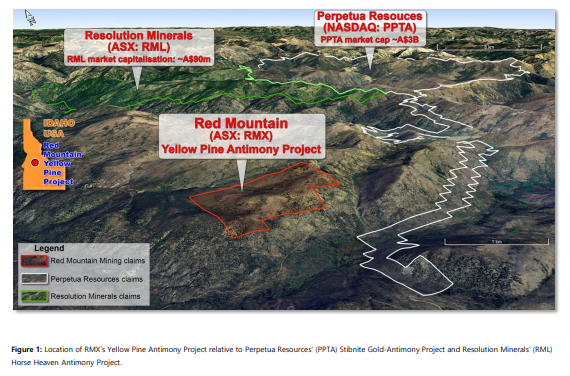
Red Mountain Mining Limited a gold and critical minerals exploration and development company, is pleased to announce that it is has acquired claims 29 claims less than 2km southwest of Perpetua Resources’ (Nasdaq: PPTA / TSX: PPTA) Stibnite Gold-Antimony Project in central Idaho, USA. RMX’s Yellow Pine Antimony Project (Figure 1) is located within the Stibnite Mining District, which was a major source of antimony in the first half of the 20th Century. Recorded production from the Yellow Pine and Hangar Flats deposits between 1932 and 1952 totaled 39,930 tonnes of Antimony1. These two deposits and the West End Deposit, which produced gold and silver from 1978 to 1997, collectively comprise the Proven and Probable Reserve of 104 Mt @ 1.33g/t Au and 0.06% Sb for 4.8Moz Au and 148Mlbs Sb for Perpetua’s Stibnite Project1 , which is the largest known stibnite deposit in the USA. The rich endowment and exploration potential of the Stibnite District has also been recognised by Resolution Minerals (ASX: RML), whose Horse Heaven Antimony Project lies immediately west of Perpetua’s claims and approximately 5km north of RMX’s project area.
Antimony-gold-tungsten mineralisation in the Stibnite Mineral District
Antimony-gold-tungsten mineralisation in the Stibnite Mining District is structurally controlled along early Tertiary north-south striking regional scale faults and smaller northeast-striking splays and is hosted in the Cretaceous granitoids of the Idaho Batholith and adjacent Neoproterozoic to Paleozoic metasedimentary roof pendant rocks (Gillerman et al., 19922 ).
Gillerman et al. (1992) suggest that mineralisation in the Stibnite District combines some characteristics of epithermal, intrusion-hosted, and orogenic gold deposits, as well as the Carlin-type, sedimenthosted gold systems of Nevada. They interpret the mineralisation in the Stibnite District to be twostage, with earlier Palaeocene gold mineralisation associated with zones featuring sulfidation of Febearing minerals, principally biotite in the Cretaceous granitic rocks, but also Fe-bearing silicates in the metasedimentary rocks. Biotite is altered to muscovite with sulfides precipitated along the mica cleavages. Sulfides are also present in quartz-carbonate veins with potassium feldspar envelopes and pervasive secondary potassium feldspar alteration in igneous rocks. In metasedimentary rocks, the metamorphic minerals near Au-mineralized zones and veins are also strongly altered. Gold is principally hosted in arsenian pyrite.
Antimony mineralisation in the Stibnite District postdates gold mineralisation. Stibnite-carbonatequartz veins and stibnite-matrix breccias cut auriferous pyritic zones along fractures and dilational zones associated with the Tertiary fault system. Tungsten, as scheelite, is also late and locally coexists with the stibnite.
Significant exploration potential of RMX’s Yellow Pine Antimony Project
2017 geological mapping by the Idaho Geological Survey3 shows that RMX’s claims feature similar prospective geology to that seen within the Perpetua Resources’ Stibnite Project area, with folded Ordovician to Cambrian metasediments intruded by Idaho Batholith granite and cut by a major NNE-trending Tertiary fault, with associated tectonic brecciation and evidence of historical mining activity, most likely seeking gold and/or antimony (Figure 2).
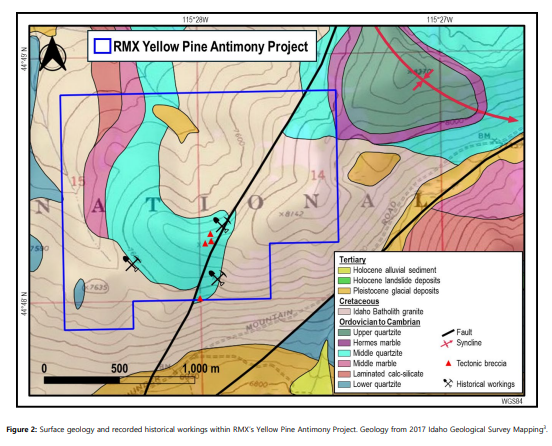
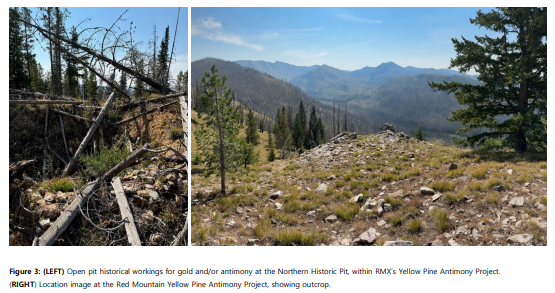
There is no evidence of modern exploration activity within RMX’s claims. However, reconnaissance mapping by RMX’s field crew has confirmed the presence of tectonic breccias within quartzite associated with the main NNE-trending fault (Figure 2 and Figure 3), which indicates that hydrothermal fluid circulation occurred along the structure. Red Mountain geologists also successfully located the two eastern historical workings mapped by the Idaho Geological Survey, which are small shallow pits that appear to be targeting brecciated quartz veins (Figure 3), likely seeking gold and/or antimony.
The total cost involved to acquire the claims was approximately $52k through direct staking with the BLM. The Yellow Pine Antimony Project claim numbers are TM-1 to TM-29, expiring on 1/9/2026 and covers 242.46 Hectares in total.
Full ASX Announcement: https://hotcopper.com.au/threads/ann-acquisition-of-yellow-pine-antimony-project-in-idaho.8787646/