

QMines Ltd (ASX:QML) Widespread Gold-Silver Anomalies Enhance Mount Mackenzie’s Expansion Prospects
12 November 2025
Price Sensitive Announcement $
Highlights:
- Large, Coherent Gold Anomalies Defined: Reprocessing of 3,114 historical soil samples has delineated multiple kilometre-scale, gold–arsenic–silver anomalies at the Mount Mackenzie Project.
- Advanced Statistical Re-analysis Unlocks New Targets: Modern techniques have harmonised multi-decade datasets, revealing previously obscured geochemical corridors and new drill-ready gold targets.
- Five Priority Anomalies Identified: Five zones display strong high-sulphidation signatures, pathfinder enrichment and alteration indices typical of productive epithermal systems.
- Strong Alignment with Structural & Magnetic Data: Gold-pathfinder anomalies coincide with magnetitedestruction and structural intersections, highlighting multiple high-priority targets for immediate drilling.
- Drilling Underway & Next Steps Defined: Multi rig drilling program is currently testing the North Knoll resource extensions with follow-up RC drilling to evaluate the new geochemical and geophysical anomalies
Overview:
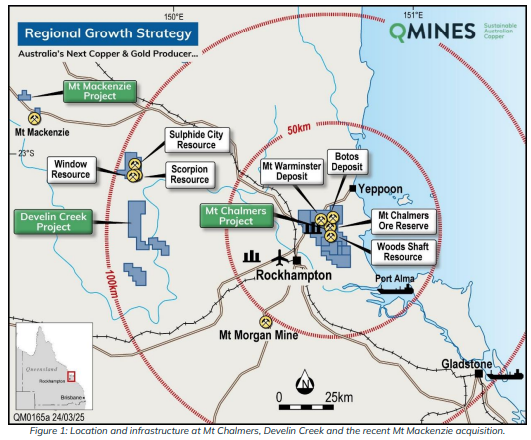
QMines Limited has announced that detailed reprocessing, standardisation and interpretation of multi-generation historical soil geochemistry has significantly advanced the geological understanding of the Mount Mackenzie Gold Project (MDL 2008) located approximately 130 km north-west of Rockhampton in central Queensland.
The results define multiple coherent gold–arsenic–silver anomalies consistent with a high-sulphidation epithermal gold system developed along the Connors–Auburn Arc. These outcomes support previous interpretations that mineralisation at Mount Mackenzie forms part of a regionally extensive magmatic– hydrothermal corridor extending north toward Clive Creek.
The work is based on re-processing and statistical normalisation of historical soil data collected by several operators between 1987 and 2019. Each of the previous surveys utilised different parameters (e.g laboratory, analysis method, collection method, etc). Comparing the results of different surveys can be problematic without first removing the effects of some of these variables. On acquisition of the project, multi-element geochemical analyses from a total of 3,114 samples were included in the database. No new samples have been collected by QMines at this stage.
QMines undertook a comprehensive compositional re-assessment using centred log-ratio transformation and median–MAD standardisation to eliminate analytical and collection bias and harmonise datasets. The resulting standardised data were used to calculate High-Sulphidation, Base-Metal Leakage and Alteration indices, which together delineate a gold-anomalous corridors and several new drill-ready targets.
Company Notes:
Exploration Manager, Tom Bartschi, commented:
“These results provide an important step forward in understanding the scale and coherence of the Mount Mackenzie gold system. The reprocessing and statistical normalisation of more than 3,000 historical soil samples has defined multiple, broad gold–silver–arsenic anomalies that are spatially consistent with key magnetic and structural features. Together, these datasets point to a large, integrated hydrothermal system with several near-surface targets that remain completely untested by drilling.”
“With our multi-rig drilling program now progressing, this work gives us a much clearer framework for prioritising targets and assessing mineralisation continuity. The correlation between geochemical and geophysical vectors strengthens our geological model and supports a data-driven systematic expansion of the known mineralised footprint at Mount Mackenzie.”
Full ASX Announcement: https://hotcopper.com.au/threads/ann-extensive-gold-anomalies-strengthen-mt-mackenzies-potential.8879260/