
Power Minerals Ltd (ASX:PNN) Delivers Conceptual Development Study For The Incahuasi Lithium Project
Highlights:
§ Conceptual Development Study for the Incahuasi Lithium Project, part of Power’s wider Salta Lithium Project in the lithium triangle of Argentina delivers robust outcomes
§ The Study confirms the Project’s technical viability and delivers a clear, viable development pathway for the project
§ Study completed by Power and its Incahuasi Project JV partner Summit Nanotech and provides an attractive baseline to continue development of the Project towards production
§ The Study contemplates a high-purity lithium carbonate (99.95% Li2CO3) producing 5,000tpa lithium carbonate over a 20-year mine life
§ The Study is based on the Project’s current JORC 2012 Measured and Indicated Mineral Resource, of 235,073t LCE – with future Resource expansion potential
§ The Incahuasi Project is now positioned to advance to the prefeasibility study phase
Overview:
Power Minerals Limited announce robust outcomes from a Conceptual Study (Study) completed at the Incahuasi Lithium Project (Project), within its wider Salta Lithium Project in the lithium triangle of Argentina.
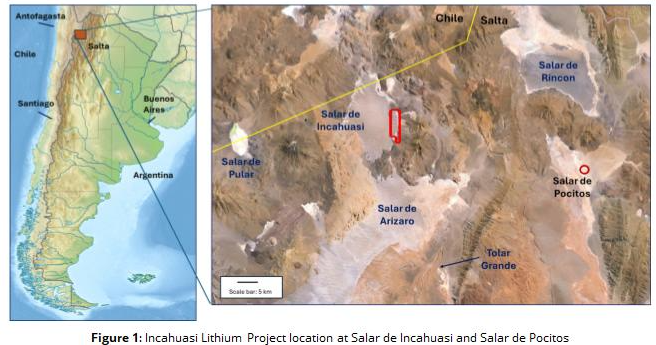
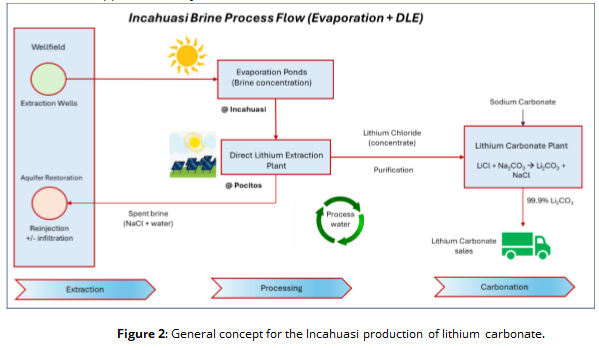
The Study considers brine extraction and concentration on-site by evaporation, followed by transportation of the brine concentrate to a shared, central direct lithium extraction (DLE) facility at Pocitos (Figure 1) for lithium recovery and eluate purification via Summit’s denaLiTM technology followed by conversion to lithium carbonate.
The Study was undertaken by Power and its joint venture partner at the Incahuasi Project Summit Nanotech Corporation (Summit) (JV Partners) to establish the technical viability of the Project. Economic outcomes await further engineering and costing, and are not included here.
The outcomes of the Study indicate that the Project may be technically viable and robust (based on assumptions and scenarios presented in the Study), and provide an attractive baseline for the JV Partners to continue development of the Project towards production, with a prefeasibility study, the next step.
The Study contemplates producing high-purity lithium carbonate (99.95% Li2CO3) at the rate of 5,000tpa lithium carbonate over a 20-year project life.
The Study is based on the Project’s JORC 2012 Measured and Indicated Mineral Resource, of 235,073t LCE (ASX announcements, 23 and 24 May 2023). Potential may exist to increase the production profile and/or the mine life contemplated in the Study based on future Mineral Resource upgrades at the Project but have not been addressed in the Study.
INCAHUASI CONCEPTUAL DEVELOPMENT – SUMMARY
Key Conclusions
Dr Nicholas M. Lindsay, a member of the Australian Institute of Geoscientists, has prepared the study report.
The production of lithium carbonate comprises brine extraction and concentration on-site by evaporation, followed by transportation of the brine concentrate to a shared, central DLE facility at Pocitos for lithium recovery and eluate purification by denaLiTM, followed by conversion to lithium carbonate.
In conclusion, the project has sufficient resources for proposed production of 5,000 tpa lithium carbonate. The study provided a logical and attractive baseline from which the JV partners (Power Minerals and Summit Nanotech) can continue to develop the project towards production with the next step being a prefeasibility study
Introduction
Power Minerals Limited and Summit Nanotech Corporation (“Summit”) (together “JV Partners”) have completed a conceptual study to establish the technical viability of the Incahuasi Lithium Project in preparation for further development.
The development option under consideration is a 5,000 tpa lithium carbonate operation based on brine extraction and concentration at the Incahuasi salar, followed by trucking of brine concentrate to a central facility at Pocitios for processing by denaLiTM, and conversion to lithium carbonate. As such, this report focuses on exploration, conceptual development and indicative costing of the project based on the JORC Measured and Indicated mineral resource of PNN’s Incahuasi project.
Location
The project area is located in the Puna of north-western Argentina in the Department of Los Andes of the Province of Salta (Figure 1). It comprises the brine field located at 3450 metres above mean sea level (masl), the Salar de Incahuasi near the town of Tolar Grande, and a shared central DLE and carbonation plant located at 3750 masl at the Salar de Pocitos industrial park (“Pocitos”). These are 360 and 275 km west of Salta city, respectively.
The Incahuasi lithium brine field is covered by the 2,000-hectare Sisifo mining lease (Role No. 19,545) registered in the Province of Salta, owned 100% by Power Minerals. The Company also has additional mineral concessions on the Salar de Pocitos and nearby Salar de Rincon, which may be integrated into the central processing plant at Pocitos. Comprehensive environmental baseline studies have been completed over all these properties.
Geological Setting
The Puna region, which hosts the Incahuasi project, comprises a series of sub-parallel north-south trending intermontane ridges and valleys. The deep basins are filled with continental sediments and have closed internal drainage systems, where salts in groundwaters are concentrated by evaporation, resulting in brine-saturated salars.
The physiography of the region evolved within a compressive tectonic setting related to shallow subduction of the Nazca Plate beneath the western margin of South America (Isacks, 19881); where lateral forces produced high-angle reverse faults that created the basin and range terrain observed.
There are also numerous stratovolcanoes and calderas of the Altiplano-Puna Volcanic Complex (APVC), which geophysical studies have shown to be underlain by an extensive magma chamber at over 4 km depth (Ward et al., 20142). This may well be the ultimate source of the anomalously high values of lithium in the area.
Exploration and Mineral Resource
The Company executed four diamond drill holes at the Salar de Incahuasi for 1,041 metres in total, from which brine and sediment samples were taken for analysis.
Brines extracted during exploration were measured for density, conductivity, pH and temperature. The total dissolved solids (TDS) varied from 323,000 mg/L to 335,000 mg/L, and conductivity varied from 226 mS/cm to 233 mS/cm. The density was constantly above 1.2 g/ml, indicating the homogeneity of the brine throughout the drillholes. Brine samples were sent for chemical analysis, and undisturbed core samples were sent off for Relative Brine Release Capacity (RBRC), or drainable porosity tests. It was observed that the samples are unconsolidated, with the range of drainable porosity acceptable for such sediments. Data was subsequently collated and interpreted into a hydrostratigraphic model for resource estimation.
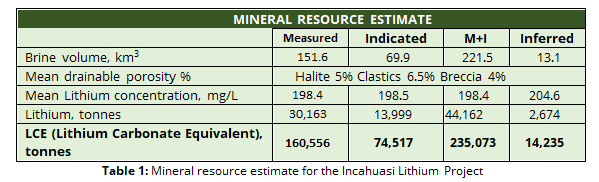
The resource (Measured + Indicated) comprises a brine volume of 221.5 km3 with an average drainable porosity of 5.4 % and a mean lithium grade of 198 mg/L, for a total lithium content of 44,162 tonnes, or 235,073 tonnes lithium carbonate.
This has a nominal cut-off grade of 100 mg/L Li. This is summarised on Table 1. It was estimated and reported in accordance with the JORC Code (2012) by a Competent Person as defined by that code in an ASX release dated 23 May 2023, “Substantial Lithium Brine Resource at Incahuasi Salar”.
Wellfield Design
A pump test well, PM24-IN-RW-01, was executed on Platform 1, a short distance from diamond drill hole PM22-IN-01, which was used as an observation well. The drilling was completed to 380 metres. The well was finished with a casing of 8 inches inserted to 360 m. Pumping was designed to hydraulically stress the aquifer with a series of step and continuous tests and obtain data for the generation of hydraulic parameters. The following was concluded:
· The aquifer is comprised of halite overlying gravel units. The ultimate design of the well permitted the calculation of the hydraulic properties of aquifers as a unique unit.
· The calculated efficiency of the pumping well was calculated at 71% for 21 L/sec, and the results of the 24-hour test indicated that the capacity of the well is 20 L/sec or more.
· The transmissivity estimated in the 144 hours of pumping at 12 L/sec was similar to the transmissivity estimated for 24 hours of pumping at 20 L/sec (3074 and 3083 m3/d respectively).
· The aquifer has in the area of influence of the pumping well, a hydraulic conductivity (k) of 9.5 m/d.
· The brine level achieves a steady state within minutes indicating that the aquifer transmits brine rapidly.
It was recommended that additional tests should be done to check lateral boundaries effects, and that further drilling be done to test separate aquifers to estimate hydraulic properties of each one.
Brine Testwork
Incahuasi brine was tested using evaporation as well as several proprietary direct lithium extraction processes (DLE3). Tests for DLE efficacy from several technology providers resulted in Summit Nanotech’s denaLiTM process4 being selected for further DLE tests and project technology partnership.
Benchtop Tests: Evaporation
The evaporation study on Incahuasi brine was conducted by Ad Infinitum5 and showed that an acceptable brine concentrate could be obtained with treatment with sodium sulphate and potassium chloride to remove impurities. The brine concentrate had a concentration of 3.24% Li with 4.77% Mg and 0.01% Ca.
Benchtop Tests: DLE
The suitability of Summit Nanotech’s denaLi™ technology for extracting lithium from a sample of Incahuasi field brine was tested at the bench-scale at Summit’s laboratory located in Calgary, Canada in August 2023. The testing involved lithium recovery from brine by adsorption with a dilute lithium chloride solution to obtain a lithium-rich eluate with reduced impurities over five cycles. The lithium recovery was 98%, while most impurities were rejected between 92 and 99%. The working capacity was 5.5 mg Li/g sorbent.
Pilot Plant Tests: DLE
Benchtop DLE tests were followed by pilot plant testwork. Summit Nanotech conducted these tests at their denaLiTM DLE pilot plant in Santiago, Chile in early 2024 using a single-column DLE unit. For this, PNN supplied 60,000 litres of raw brine extracted from all four boreholes at their Sisifo property on the Incahuasi salar. Initial column profiling and conditioning were followed by a continuous extraction phase to generate the necessary data to satisfy eventual PFS engineering requirements. A lithium recovery rate of 95% was achieved during piloting, with overall impurity rejection of 99.3% from feed brine to eluate. A lithium chloride eluate stream of 460 mg/L Li was produced out of the extraction column with an estimated TDS of 6.6 g/L.
Process Design & Engineering
Detailed process design and engineering is incomplete at this stage. However, the proposed flowsheet for the project is shown in Figure 2. While not specific in engineering, this study scopes out brine extraction and concentration at the Incahuasi brine field, with DLE and carbonation at Pocitos. Brine concentrate from Incahuasi will be supplemented by raw brine from PNN’s tenements on Salar de Pocitos.
Recommendation and Next Steps
It is the recommendation of this study that the Incahuasi Lithium Project be advanced towards the prefeasibility study phase. This needs to be supported by a pilot evaporation operation on-site at Incahuasi, a DLE demonstration plant, and advances in wellfield development. Comprehensive geotechnical studies, logistic studies, advanced civil and structural engineering and costing are still required. Areas requiring particular attention include:
· Resource and Wellfield Planning – hydrogeology and additional pump test wells
· Geotechnical studies
· Pilot evaporation ponds on-site
· DLE demonstration plant using brine concentrate as well as blending raw brines from PNN properties on Rincon and/or Pocitos. These may be important for reducing the lithium tenor of the DLE plant feed.
· Advanced project civil and structural engineering, and cost study.
· Logistics study for brine concentrate transportation from Incahuasi to Pocitos
· Additional environmental studies related specifically to the impact of evaporation at Incahuasi and utilisation of Pocitos and Rincon brines at the central DLE facility at Pocitos.
· Water exploration for industrial water at Pocitos, including current activities on PNN properties in the area.
Company Notes:
“We are delighted with the outcomes of the Incahuasi Conceptual Development Study, one of the core assets of our Salta Lithium Project in Argentina. In conjunction with our Incahuasi joint venture partner Summit Nanotech, we are committed to advancing the Project as a future long-term producer of high-purity lithium carbonate, and the Conceptual Study provides a logical and technically feasible measure of the project’s development viability.
Incahuasi will now progress to the prefeasibility study stage, which will seek to further define the Project’s economic and technical parameters as a future lithium carbonate-producing operation. In parallel, we also continue to progress development of our Rincon asset within the wider Salta Lithium Project, to deliver a significant future lithium-producing hub at Salta.”
Power Minerals Managing Director Mena Habib