

Magnum Mining and Exploration Limited (ASX:MGU) Advances Large-Scale IAC REE Discovery at Piracanjuba
1 June 2026
Price Sensitive Announcement $
Highlights:
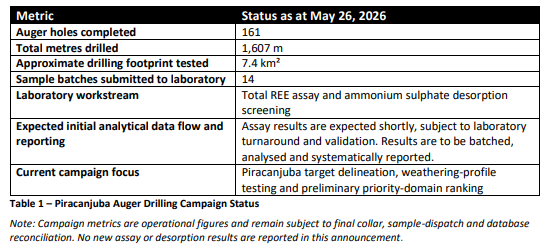
- 161 auger holes and 1,607 metres completed to date at the Piracanjuba North Target within Magnum’s wholly-owned Azimuth REE Project in Brazil
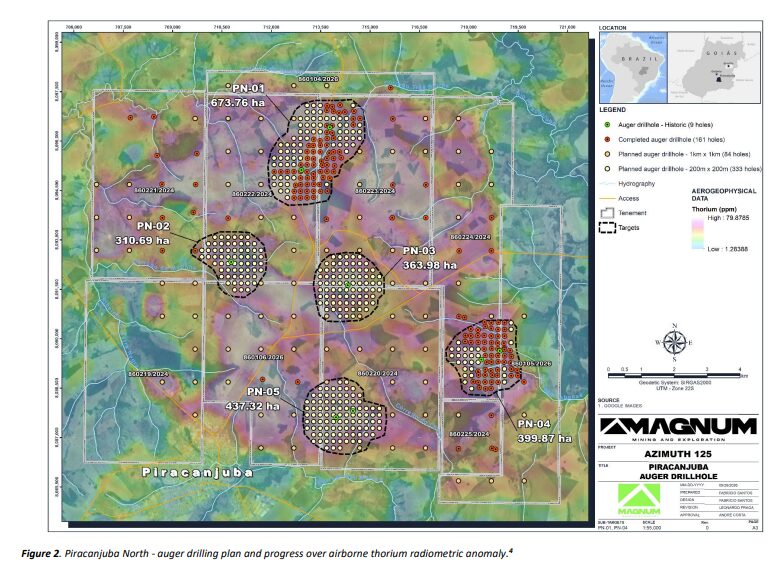
- Drilling has now been completed across an approximately 7.4km² priority area, extending sample coverage beyond the initial PN-04 follow-up footprint
- 14 sample batches have been submitted to the laboratory for total REE assay and ammonium sulphate desorption screening
- Magnum expects to regularly report batches of REE assay and desorption results over the coming months as the 810-hole auger programme progresses across the Piracanjuba Prospect
- Desorption recoveries of up to 75% TREO and 94% MREO have demonstrated the potential to recover high-value strategic rare earth elements under mild leaching conditions, enhancing the prospectivity of the Piracanjuba prospect
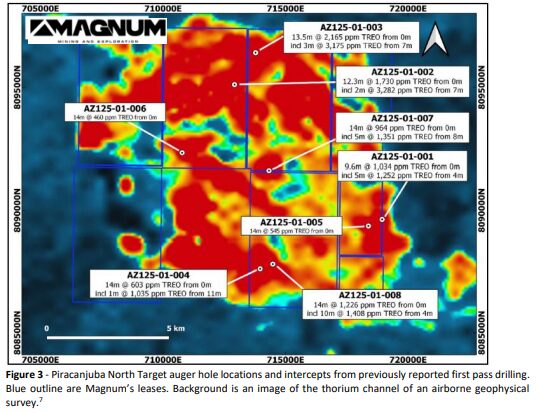
- Exceptional first assays of up to 3,971ppm TREO and 1,360ppm MREO, with an excellent high-grade MREO distribution from holes drilled
- The 85km² geophysical footprint at Piracanjuba North and wide drill hole spacing of up to 5km suggest a laterally extensive ore body
- Exploration Target expected by September 2026, with a JORC Mineral Resource Estimate targeted for November 2026, subject to exploration results
- The Azimuth REE Project is located within the Azimuth 125° Lineament, a prominent crustal-scale structural feature, only ~50km from CMOC’s Catalão Project — one of Brazil’s highest-grade niobium mines
Overview:
Magnum Mining and Exploration Limited, a critical minerals explorer with 100% ownership of the Azimuth REE Project in Brazil, is pleased to provide an operational update on the ongoing auger drilling campaign at the Piracanjuba Target within the Goiás South District of the project.
As of 26 May 2026, Magnum has completed 161 auger holes for 1,607 metres of drilling across approximately 7.4km² of priority area, with 14 sample batches submitted to the laboratory for total REE assay and ammonium sulphate desorption screening. Drilling and sample dispatch are continuing, with the programme remaining on track to support delivery of an Exploration Target by September 2026 and a JORC Mineral Resource Estimate by November 2026, subject to exploration results.

A large-scale IAC system taking shape
The current campaign at Piracanjuba is designed to expand the dataset beyond the initial PN-04 follow-up holes and test whether shallow IAC-style REE responses can be repeated across a broader regolith and saprolite footprint. The decision to accelerate exploration with a systematic 810-hole, ~10,000m auger drilling programme was based on several compelling technical factors: desorption recoveries of up to 75% TREO and 94% MREO demonstrating the potential to recover high-value strategic rare earth elements under mild leaching conditions; exceptional first assays of up to 3,971ppm TREO and 1,360ppm MREO; all 13 first-pass auger holes intersecting near-surface REE mineralisation and terminating in REE mineralisation; and the scale of the broader 85km² geophysical footprint validated with first-pass drill hole spacing of up to 5km.
The programme consists of two complementary components. A 1,000m x 1,000m grid drilling programme is designed to test the lateral extent of REE mineralisation across the Piracanjuba prospect and potentially support the definition of a JORC Exploration Target expected by September 2026. A tighter 200m x 200m grid drilling programme centred on previously reported REE intercepts is targeting a JORC-compliant Mineral Resource Estimate expected by November 2026.
Pending laboratory results will be reviewed for lateral repeatability, grade-thickness relationships, vertical profile position, total TREO versus ammonium sulphate desorbable TREO, magnet REE distribution, QAQC performance and geological consistency. The first technical decision enabled by the pending data will be whether results support continued systematic grid drilling, selected infill, step-out drilling, deeper follow-up, and targeted mineralogical and geometallurgical work.
Strategic location in a tier-1 REE jurisdiction
The Azimuth REE Project is located within the Azimuth 125° Lineament — a prominent crustal-scale structural feature in the State of Goiás, Brazil — approximately 50km from CMOC’s Catalão Project, one of Brazil’s highest-grade niobium mines. Brazil is rapidly emerging as a strategic REE jurisdiction of choice for Western and allied markets, with ionic adsorption clay deposits particularly attractive due to their amenability to low-cost, mild leaching extraction methods. The scale of the Piracanjuba system, if confirmed through ongoing drilling, has the potential to position Magnum as a significant participant in the global critical minerals landscape.
Company Notes: Managing Director Antonio Vitor commented: “We are very pleased with the safe and rapid progress being made by our Auger drilling crews at Piracanjuba, where we continue to systematically follow up on the exciting ionic adsorption clay REE discovery we have made. With 161 auger holes already completed, the programme remains on track to support our goal of delivering an Exploration Target by September and a JORC Mineral Resource Estimate by November, subject to exploration results.
“Whilst exploration remains at an early stage, the 85km² geophysical anomaly at Piracanjuba supports the potential for a globally significant REE IAC system. First-pass drilling across the wider Piracanjuba prospect also showed that all 13 auger holes intersected and ended in IAC-hosted REE mineralisation, despite drill hole spacing of up to 5km. Brazil is rapidly emerging as a strategic REE jurisdiction of choice for Western and allied markets, and we believe Piracanjuba has the potential to become a significant rare earth opportunity within this landscape.”
Full ASX Announcement: MGU Full ASX Announcement