

Great Northern Minerals (ASX:GNM) Catalyst Ridge REE-Antimony Expansion in Mountain Pass USA
9 September 2025
Price Sensitive Announcement $
Highlights:
- The Company has filed field staking applications for an additional 96 lode claims covering approximately 8.03km2, expanding the overall footprint of the Catalyst Ridge Project.
- The new claims complement the existing 119 lode claims at Catalyst Ridge (see ASX Announcement dated 22 Aug 2025), which is located in the world’s mostly highly sought after rare earth corridor positioned within a strategic US critical metals hub.
- New claims areas also occur in a similar geological and structural setting to the Mountain Pass and Colosseum Gold deposits and therefore also considered highly favourable for both REE and antimony-gold mineralisation at Catalyst Ridge.
- New claims areas contain intersecting structures which are considered highly prospective for REE-bearing carbonatite intrusions, and also extensive magnetic high features similar to those observed at the Colosseum Magnetite-carbonate breccia gold deposit.
- The new claims area will be integrated into the exploration strategy for the Catalyst Ridge Project, which is currently being developed with a systematic geochemical sampling program expected to commence in the coming weeks.
Overview:
Great Northern Minerals Ltd has announced that it has completed the field staking applications for an additional 96 lode claims prospective for rare earth elements (REE) and antimony (Sb), located within the Mountain Pass District, in California’s Mojave Desert. The 96 lode claims which have been applied for, are in addition to the claims being acquired by GNM pursuant to the ASX Announcement of 22 August 2025. These lode claims will significantly expand the overall existing footprint of the Catalyst Ridge Project
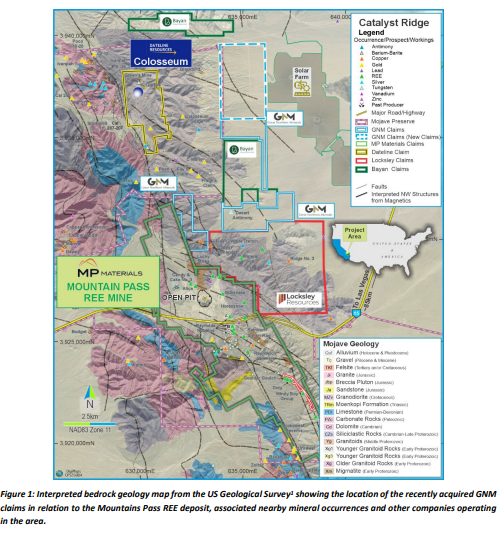
Catalyst Ridge New Project Claims & Regional Geology
The new claim area comprises of 96 lode mining claims in the Proterozoic REE Belt of Mountain Pass Area, California. The 96 claims are located 10km north of both the Mountain Pass Mine and the associated Processing Facility owned by MP Materials Corp. (NYSE:MP) (MP Materials) and also in very close
proximity to the Mojave Project owned by Locksley Resources Ltd (ASX:LKY) (Locksley). Mountain Pass is the only producing rare earths mine in the USA.
The lode mining claims have been filed with San Bernardino County Recorders office in San Bernardino, California and sent to the US Department of Interior Bureau of Land Management (BLM) California State Office located in Sacramento, California. All filing and recording fees have been paid by the Company to validate the mineral rights. Under the BLM system, mineral claims are awarded on a first-come, first served basis, however there is no guarantee that all claims will be granted with the tenure status of the claims being subject to final confirmation by the BLM. GNM will provide an update to the market once the lode claims have been officially confirmed by the BLM.
As indicated in GNM’s ASX announcement dated 22 August 2025, until recently, MP Materials, who own the Mountain Pass REE Mine, was solely focused on their current mine foot print and build up at their mine site and not regional exploration. In the last couple of years exploration along the 10km REE Mesoproterozoic trend has intensified by other companies to further identify other REE occurrence along the trend and their potential economic viability. It should also be noted that the nearby Colosseum gold magnetite-breccia deposit held by Dateline Resources Ltd (ASX:DTR) (Dateline) and nearby associated antimony occurrences are thoughts to also be related to the emplacement of the Mountain Pass carbonatites4.
Currently Locksley and Dateline have been active in exploration efforts in the region. Recent work by GNM has indicated that the Catalyst Ridge Project, including the new 96 lode claims, occurs in a highly prospective ground position based on regional geology, detailed airborne magnetics, gravity and radiometrics.
Geological & Geophysical Review of the New Claim Area
The new claim area is located within the overlaying Permian to Devonian limestones that conceal the Proterozoic granites beneath. Northwest and north-northwest-trending structures are widely regarded as a key control on the formation and localisation of the carbonate pipes and dykes that host the REE mineralisation throughout the Mountain Pass area2 and the regionally extensive structures have been mapped on the USGS regional geology maps1. GNM recently acquired open file 100m to 200m spaced Airborne Magnetic, Radiometric and HeliFALCON Airborne Gravity Gradiometer Data over the entire project area3 to assist in the review of prospectivity of the Catalyst Ridge Claim area.
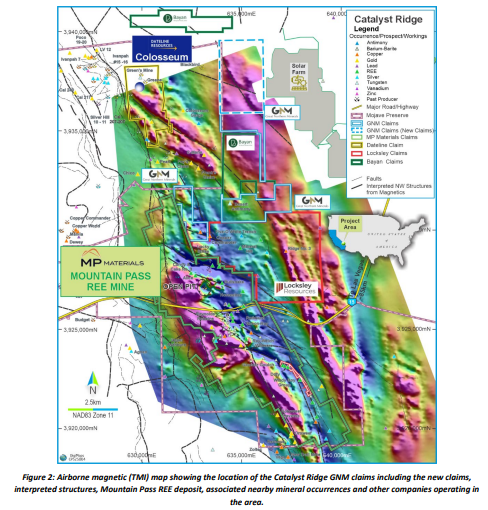
The detailed magnetic data reveals highly compelling interpreted northwest- and north-northwesttrending structures that occur within the new claims where two intersecting northwest- and northnorthwest-trending structures intersect (Figure 2). These structures are considered highly prospective for REE-bearing carbonatite intrusions. It is also important to note that the Colosseum gold carbonatemagnetite breccia deposit and nearby antimony occurrences are considered genetically linked to the carbonatite intrusive activity in the district4 and also occurs associated with northwest and northnorthwest-trending faults within the overlaying Permian to Devonian limestones (Figures 1 & 2).
Interestingly, the new claims contain extensive magnetic high features similar to those observed on Datelines ground to the west including the Colosseum Magnetite-carbonate breccia gold deposit (Figure 2).
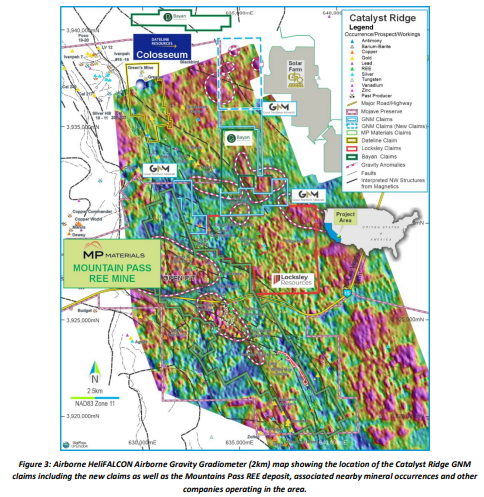
Another important part of the review relates to the gravity geophysics data acquired in the area. Previous geophysics work at Mountain Pass have indicated that the intrusive suite associated with the mineralisation occurs associated with an observed “gravity terrace” of moderate strength4 that occurs on the flanks of circular lobate gravity high features. This suggests carbonatite magmatism is related to the edges of deeper dense intrusions that can be mapped with gravity. Interestingly, the new claims are associated with at least 4 prominent gravity features where the edges may indicate higher prospectivity areas in the search for REE or other metals such as gold and antimony and therefore require further field investigation to assess the potential.
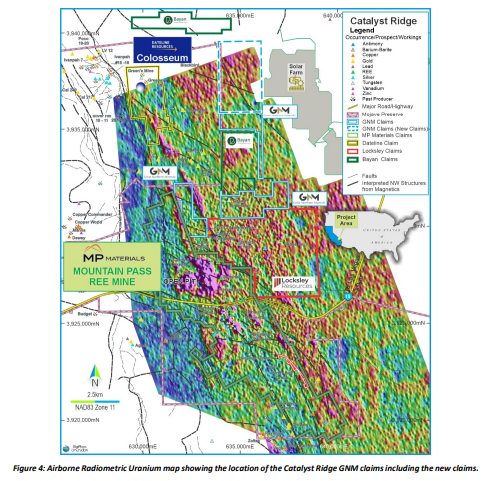
Another interesting aspect of the new ground to the north is that the area contains several radiometric uranium anomalies on the ground (Figure 4) which may be important since the Mountain Pass REE deposit itself is widely known to be associated with uranium mineralisation1,2 so these anomalies require further field investigation to assess their REE potential.
Ongoing Exploration at Catalyst Ridge
Review of the magnetic, radiometric and gravity geophysics over the new claims has again indicated several interesting anomalies and interpreted structures supporting the high prospectivity of this area for REE mineralisation and antimony and has added significant value to the whole package. The new claims area will be integrated into the ongoing exploration strategy for the Catalyst Ridge Project which is currently being developed with a systematic geochemical sampling program expected to commence in the coming weeks. The systematic geochemical sampling program will focus on the targets and structures identified from the geophysical review. The aim of this work is to vector into areas of outcropping REE
or antimony-gold mineralisation with the view to developing drill targets for drill testing.
Company Notes:
Non-Executive Chairman, Eddie King, commented: “The expansion of the footprint of the Catalyst Ridge Project through the addition of the 96 new claims strengthens GNM’s intended strategic presence within one of the United States’ most critical regions for the exploration of critical minerals.
We are excited to stake freely available ground with very interesting geophysical features that have shown the potential to host deposits of globally significant scale and importance. We are excited to work closely with our US-based geology team to begin fieldwork in the coming weeks.”