

GoldArc Resources Ltd (ASX:GA8) New Blind Gold Mineralised Zones Discovered at Leonora South
27 January 2026
Price Sensitive Announcement $
Highlights:
- Maiden Aircore (AC) drilling has successfully identified new gold mineralised systems under cover at the Whistler Prospect (E40/415) within the Leonora South Gold Project.
- Drilling identified four distinct mineralised zones, with the easternmost zone openended and coinciding with a magnetic low.
- Encouraging shallow, gold intercepts returned include:
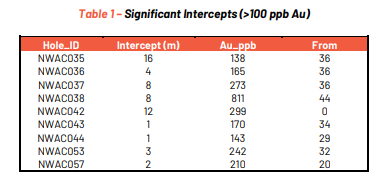
o 16m @ 138 ppb Au from 36m in hole NWAC035 including 4m @ 341ppb Au from 36m
o 8m @ 273 ppb Au from 36m in hole NWAC037 including 4m @ 434ppb Au from 40m
o 8m @ 811ppb Au from 44m in hole NWAC038 including 4m @ 1,520ppb Au from 44m
o 12m @ 299ppb Au from 0m in hole NWAC042 including 4m @ 545ppb Au from 8m
o 3m @ 242ppb Au from 32m in NWAC053
o 2m @ 210ppb Au from 20m in NWAC057 - First pass AC drilling at Jessop Creek (E40/413) returned promising cobalt-silver,
chromium-nickel-copper and zinc-lead intercepts including:o 28m @ 22% Fe, 5,573ppm Cr, 1,477ppm Ni and 954ppm Cu from 4m including 12m @ 278ppm Co from 16m in NJAC029
o 4m @ 9% Fe, 753ppm Zn and 447ppm Pb from 44m in NJAC032
o 1m at 1,016ppm Co and 0.26ppm Ag from 4m in NJAC008 - Results provide a strong indicator of potentially unrecognised, significant gold mineralisation within the Leonora South Project.
- RC and AC drilling programs are scheduled to commence in the coming months to follow up on these targets.
- Diamond drilling program has commenced on 21 January 2026 at Mt Stirling and Mt Stirling Well.
- A major ~6,500m RC drilling program is scheduled to commence in the coming month at Orion, Sapphire, Eclipse and Gladstone prospects
Overview:
GoldArc Resources Limited (ASX:GA8) has reported encouraging results from its maiden aircore (AC) drilling program within the Leonora South Gold Project, Western Australia. The program, comprising 119 holes for 3,321m, was designed to test soil anomalies at the Whistler (E40/415) and Jessop Creek (E40/413) prospects from recently conducted soil surveys (refer to 1 December 2025 announcement – High-Priority Targets Identified at Jessop’s Creek and Whistler).
All holes were drilled to refusal, with a -60o dip towards 289o (Whistler) or 270o (Jessop Creek). All samples were assayed for gold using 25 g aqua regia (AR25/MS). In addition, all single 1-metre samples from each hole were assayed, except NJAC027–NJAC033, for which all 4mcomposite samples were assayed with four acid-digest 4A/MS that included 60 elements.
See Table 1 for a list of significant intercepts. The significant 4m composites will be resampled on a 1-metre basis.
Whistler (E40/415)
The Whistler prospect features a 2.4km line of small shafts trending to 020o
in the central part of the E40/415. Prior to this program, this area had never been drill-tested.
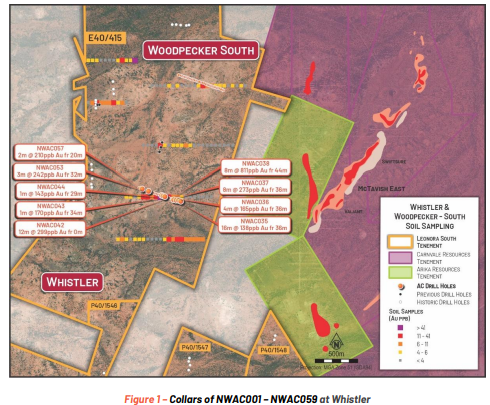
The Company completed two drill fences about 500m and 600m long and spaced 1.4km apart, located in the central and eastern part of the tenement. The southernmost drill fence has identified four gold mineralised zones with the easternmost appearing to be open-ended.
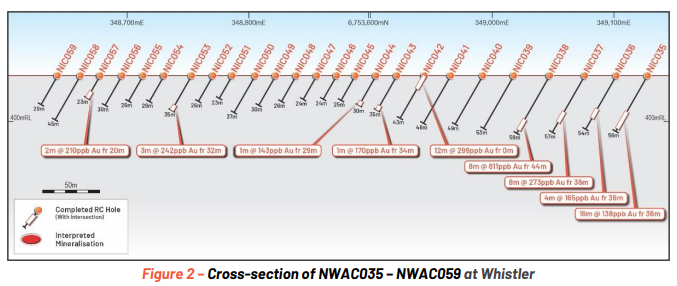
The first (easternmost) zone, approximately 100m wide, was intercepted by four holes (NWAC035-38). It returned the best gold values at downhole depth 36-52m within foliated
high-zirconium granite showing significantly deeper weathering (figure 2). The zone also coincides with a magnetic low oriented to 020o. The best result was 8m @ 811 ppb Au from 44m in hole NWAC038 including 4m @ 1,520ppb Au from 44m and 8m @ 273 ppb Au from 36m in hole NWAC037 including 4m @ 434ppb Au from 40m.
Further west, the second mineralised zone also about 100m wide was intercepted by five holes (NWAC040-44) with best gold values including 12m @ 299 ppb Au from 0m in hole NWAC042 including 4m @ 545 ppb Au from 8m within foliated high-zirconium granite. The weathering profile in this zone is slightly shallower. This zone coincides with a significant soil anomaly with maximum 89 ppb Au.
The third mineralised zone coincides with a line of small shafts of Whistler prospect where a mineralised zone returned a result of 3m @ 242 ppb Au from 32m in NWAC053. The zone
appears to be narrower and hosted by foliated high-zirconium granite possibly at the contact with basalt. The bottom 1m sample returned very low 0.27% K but highly elevated 7.26% Na suggesting strong albite alteration of high-zirconium granite, similar to Gruyere Tonalite.
Hole NWAC053 is located approximately 500m south of RC NIC064 that intersected 15m @ 0.215g/t Au from 9m.1
The weathering of high-zirconium granite between the second and third zones is substantially shallower and barren (holes NWAC045-NWAC049).
The fourth, narrow mineralised zone intercepted 2m @ 0.21g/t Au from 20m in shallow hole NWAC057 within foliated basalt at the granite contact.
The northern drill fence was relatively poorer in gold anomalism, and the weathering was overall shallow. The high-zirconium granite intercepted in AC drilling is relatively poor in K and
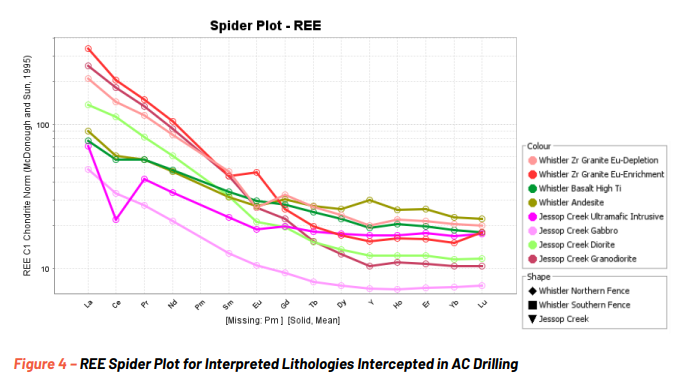
Rb and relatively richer in Na. It appears to be strongly fractionated showing comparable characteristics to Gruyere Tonalite and Ziggy Monzonite.
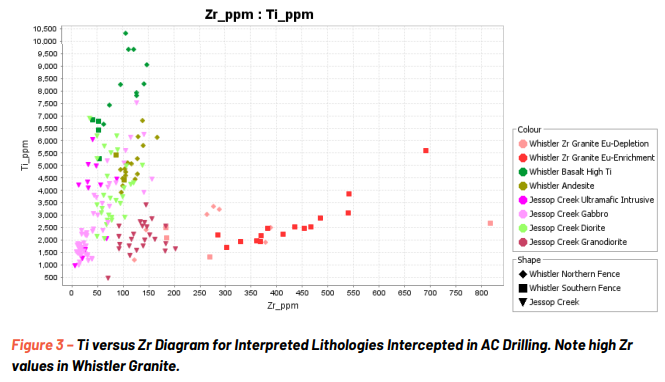
The median chondrite-normalized REE spider plot shows clearly that granite intercepted in E40/415 (Whistler) with highly unusual granite that displays Eu as a negative or positive Eu anomaly which is a signature of fractionation.
Jessop Creek (E40/413)
Sixty AC holes tested two soil anomaly grids at Jessop Creek. Two drill fences NJAC001- NJAC025 and NJAC039-NJAC060 (west) and a single fence (east) were tested. Low-level gold anomalies were intercepted in almost all holes in shallow 0-4m composite samples with up to 16 ppb Au in NJAC011. It appears that the gold anomalies are either transported or that the holes were too short due to a shallow weathering profile.
While gold results were low, the drilling intercepted significant polymetallic mineralisation.
Drilling identified silver (Ag) and cobalt (Co) anomalies consistent with soil samples including, hole NJAC008 which intersected 1m at 1,016ppm Co and 0.26ppm Ag from 4m. Anomalies of
Ag and Co in soils in the western part show similar trends as Ag and Co anomalies intersected in AC. The average drill hole depth in the western soil grid was 15m in the northern fence and
23m in the southern fence. Holes NJAC045-47 intercepted anomalous barium (Ba), cerium (Ce), lanthanum and neodymium (Nd) with best value 1m at 3,516ppm Ba, 829ppm Ce, 435ppm La and 278ppm Nd from 17m. The dominant lithology in the western drill fences was a medium grained intrusive rock of granodiorite to diorite composition.
The shallow weathering within the western part of Jessop Creek suggests RC drilling is required to effectively test the basement.
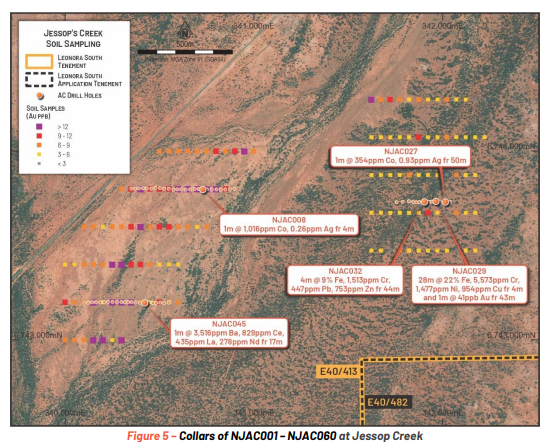
A single AC fence (NJAC026-NJAC033) in the eastern soil grid intercepted a 180m-wide zone of mainly gabbro with an ultramafic core. Hole NJAC029 intersected 28m @ 22% Fe, 5,573ppm Cr, 1,477ppm Ni and 954ppm Cu from 4m. The samples display relics of sulphides in the form of pyrrhotite. This zone coincides with the north-south trending magnetic high. The drill fence is located at the southern end of the magnetic high and continues north for at
least 5km.
The best Au intercept on that fence was returned from the bottom of hole NJAC029 where 1m @ 41 ppb Au from 43m was intersected. Interestingly, hole NJAC032 intersected 4m @ 9% Fe, 753ppm Zn and 447ppm Pb from 44m in the lower part of the hole. The average depth along this drilling fence was 38m with the deepest hole being 55m deep.
Next Steps
The Company is immediately advancing an aggressive exploration strategy following these results:
- A major ~6,500m RC development drilling program is to commence in FebruaryMarch 2026 at Orion-Sapphire-Eclipse-Gladstone deposits.
- A further soil survey has commenced northeast of Mt Stirling gold deposit, where there has been very limited historical work.
- Diamond drilling program has commenced on 21 January 2026 at Mt Stirling and Mt Stirling Well to support resource development.
Company Notes:
GoldArc Resources Managing Director, Paul Stephen commented: ”The maiden AC drilling program has proven to be a technical success, identifying ‘blind’ gold mineralisation in an area with limited historical work. At Whistler, we have defined four mineralised zones within a
geological setting that shows several similarities to felsic intrusives associated with the Gruyere deposit. In parallel, the polymetallic hits at Jessop Creek provide a new exploration dimension. We are moving immediately to advance these targets with substantial RC and AC
campaigns scheduled for the coming months.”
Full ASX Announcement: https://hotcopper.com.au/threads/ann-new-blind-gold-mineralised-zones-discovered-at-leonora-south.8989744/