

Exultant Mining Ltd (ASX:10X) Big Badja Mine Delivers High-Grade Silver Hits – Strong Potential Remains Open at Depth
31 March 2026
Price Sensitive Announcement $
Highlights:
Historic Big Badja Silver Mine Delivers High-Grade Results – System Remains Open at DepthThe historic Big Badja Silver Mine, located within the Peak View Project, has received no modern exploration or drilling until now. Initial modern work has confirmed high-grade silver mineralisation and an open anomaly at depth.Key highlights include: 339 g/t Ag, 1.8% Pb and 0.4 g/t Au – the highest-grade silver result to date from recent rock chip sampling (sample 8931-032)
This result further supports previously reported high-grade rock chip assays from the mine, including:
256 g/t Ag, 4.82% Pb and 0.36 g/t Au (sample 8931-006)
108 g/t Ag (sample 8931-004)
93.4 g/t Ag and 3.32% Pb (sample 8931-007)
63.4 g/t Ag (sample 8931-003)
A trial Induced Polarisation (IP) survey line completed over the historic mine workings has confirmed a strong chargeable anomaly directly beneath the old mine, which remains open at depth. These results demonstrate that the mineral system is highly responsive to modern geophysics, providing a clear and effective method to target potential extensions. The Big Badja Mine is situated on a prospective granite–sediment contact exceeding 15 km in length, which also hosts a 3 km-long untested Pb-Zn soil anomaly.
Overview:
Exultant Mining Limited (ASX: 10X) has reported results from recent rock chip sampling and a trial Induced Polarisation (“IP”) survey completed at the historic Big Badja Silver Mine within its Peak View Project in New South Wales.
The new rock chip and geophysical results(Fig. 1) materially strengthen the prospectivity of the Big Badja Silver Mine, confirming both the presence of high-grade silver-lead mineralisation at surface and a coincident chargeability anomaly extending beneath the historic workings. Importantly, the results demonstrate that the system responds to IP, providing the Company with a potentially effective tool to explore for extensions to known mineralisation.

Big Badja Silver Mine
The historic Big Badja Silver Mine comprises a series of high-grade quartz–galena–chalcopyrite veins dipping approximately 65° east and developed along a granite–sediment contact. Mining at Big Badja ceased in 1890 for reasons that remain unclear; however, historical records, including the Warden’s Report, document exceptionally high silver grades of up to 334 oz/t Ag (9,469 g/t Ag)3 from 6m depth within the main shaft, which reportedly reached a total depth of 30m.
The main shaft has since collapsed, and as a result, the interpreted ore zone is currently inaccessible. Despite the presence of these ultra-high-grade historical results, the Big Badja Silver Mine has never been assessed using modern exploration techniques, and no drilling has been undertaken to test the system at depth or along strike.
Rock Chip Results
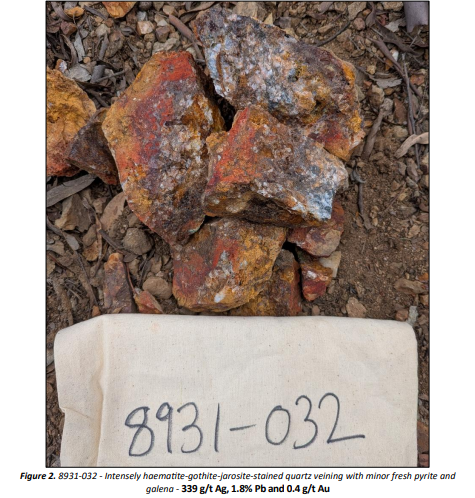
Two additional rock chip samples were collected during recent fieldwork at Big Badja. Sample EL8931-032 was collected from mullock surrounding the historic shaft and comprised intensely haematite-gothite-jarositestained quartz veining with local fresh pyrite and galena. The sample returned an exceptional result of:
- 339 g/t Ag, 1.8% Pb and 0.4 g/t Au (Fig. 2)
A second sample, EL8931-033, was collected from intensely altered purple to green haematite-stained granitic outcrop containing abundant cubic boxworks and local fresh pyrite. This sample did not return significant assay results.
The strong result from EL8931-032 is the highest-grade silver rock chip assay returned to date by Exultant from Big Badja and further supports the Company’s previous rock chip results from the mine, including1, 2:
- 256 g/t Ag, 4.82% Pb and 0.36 g/t Au (sample 8931-006)
- 108 g/t Ag (sample 8931-004)
- 93.4 g/t Ag and 3.32% Pb (sample 8931-007)
- 63.4 g/t Ag (sample 8931-003)
These results confirm the presence of high-grade silver-lead mineralisation associated with the historic workings and support the interpretation that Big Badja represents a robust mineralised system with potential to extend beyond the shallow historical mine development.
Next Steps:
Planned follow-up work at Big Badja will focus on expanding the geophysical coverage and assessing the broader prospectivity of the contact zone. This work is expected to include:
- Additional IP lines with longer arrays to achieve greater depth penetration beneath the historic mine
- Follow-up IP surveying along strike of the prospective granite-sediment contact to test for extensions to the Big Badja system
- Assessment of the suitability of IP surveying over the 3km-long Pb-Zn soil anomaly located 3km north of Big Badja
The successful identification of a chargeability response at Big Badja provides an important vectoring tool for future exploration and has broadened the Company’s capacity to target silver-lead mineralisation both at the mine and across the wider Peak View Project.
Company Notes:
Comment from Executive Chairman, Brett Grosvenor:
“Big Badja is emerging as a compelling high-grade silver target within the Peak View Project that has seen no modern exploration or drilling despite exceptional historical grades. The latest rock chip result of 339 g/t silver is our highest grade returned from the mine to date and further validates the exceptional tenor of mineralisation indicated by both historical mining records and our earlier sampling.
Importantly, the trial IP survey has identified a chargeable anomaly directly beneath the historic workings that remains open at depth. This is a significant outcome, as it demonstrates that the system can be effectively targeted using modern geophysics, something that has not previously been applied at Big Badja.
Taken together, these results point to the potential for a larger mineralised system extending beyond the shallow historical workings and provide a clear pathway for systematic follow-up exploration.”
Full ASX Announcement: Exultant Mining Ltd Full ASX Announcement