
AusQuest Ltd (ASX:AQD) Cangallo Porphyry Copper Keeps Growing – More Broad Hits Confirm Scale Potential
4 March 2026
Price Sensitive Announcement $
Highlights:
- Broad spaced RC drilling has defined a large corridor of continuous mineralisation
extending +1,500m along strike, 250-500m in width and to a depth exceeding 400m, with the footprint expected to expand with further drilling. - Significant zones of broad porphyry mineralisation were intersected in hole CANRC034, with several higher-grade zones including:
o 164m @ 0.33% Cu and 0.07g/t Au from 304m to the end of hole (EOH), including:
▪ 54m @ 0.42% Cu from 306m
▪ 26m @ 0.42% Cu from 380m
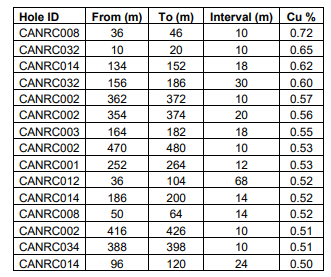
o 244m @ 0.23% Cu and 0.07gpt Au from 40 metres - Drilling to date has delivered multiple broad >0.5% Cu intervals across the corridor, confirming the system’s capacity to generate high‑grade copper. Significant results include:
o 68m @ 0.52% Cu from 36m (CANRC012)
o 30m @ 0.60% Cu from 156m (CANRC032)
o 18m @ 0.62% Cu from 134m (CANRC014)
o 10m @ 0.72% Cu from 36m (CANRC008)
o 10m @ 0.65% Cu from 10m (CANRC032) - Recent assays indicate increasing copper and gold grades toward the southern drill section, highlighting strong potential for the system to continue expanding.
- Preparations are underway for the upcoming +5,000m RC drill program, which is expected to commence in mid-March.
- +5,000m diamond drill program scheduled for April to target higher‑grade depth extensions of the copper sulphide mineralisation.
- The potential of this exciting new copper discovery continues to improve, with results confirming extensive near-surface copper oxide mineralisation and potential for higher grade hypogene mineralisation, in an excellent location close to the coast and key
infrastructure. - Copper occurs as oxides from surface to depths of ~200m to 250m, transitioning to mixed oxides and secondary sulphides to depths of +300 metres, supporting strong potential amenability to heap leach processing.
Overview:
AusQuest Limited reported further assay results from the Stage 3 Reverse Circulation (RC) drilling program at its 100%-owned Cangallo Porphyry Copper-Gold Project in Peru. A full assessment of all the newly received geochemical data is in progress.
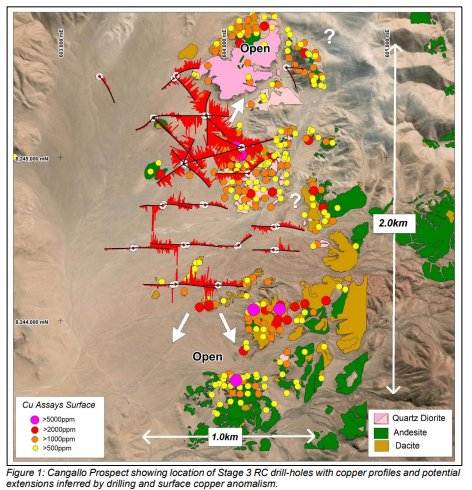
The initial phase of the Stage 3 RC drilling program was designed to extend the mineralisation intersected in Stages 1 and 2 and to further evaluate the scale potential of the Cangallo porphyry copper-gold system. Results to date continue to support the interpretation that Cangallo is a very large and laterally continuous porphyry system (Figure 1).
Assay results demonstrate continuity of the porphyry copper system from north to south, with the mineralised footprint now estimated to be at least 1,500 metres in length, 250-500 metres
wide and extending to a depth of more than 400 metres.
Importantly, diamond drill-holes CANDD001 and CANDD002 indicate that mineralisation can extend to depths of greater than 800 metres, highlighting the significant growth potential of the project.
A review of copper intersections reported from the current drilling program has demonstrated that the 0.1% Cu cut-off grade provides a good indication of the overall size of the porphyry system, but does not highlight the continuity of higher copper grades within the system.
Multiple +0.5% Cu intervals greater that 10 metres in thickness have been intersected within the broader mineralised envelope demonstrating the capability of the porphyry system to
produce higher grade copper either through supergene enrichment processes or as hypogene mineralisation within dykes associated with the system. In addition, 34 individual 2m composite samples assayed more than 0.8% Cu providing further evidence of the potential for higher copper grades within the system
Continuity of the higher-grade copper zones is unknown at this stage given the broad-spaced nature of the drilling completed to date.
Significant +0.5% Cu intersections greater than 10 metres in thickness include:
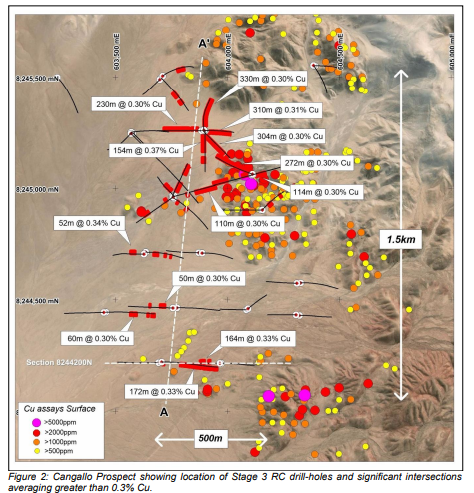
Calculations using the Micromine software package were also undertaken to check on the continuity of Cu mineralisation averaging greater than 0.3% Cu within the broader 0.1% Cu
envelope.
These calculations highlighted substantial thicknesses (50-330m) containing +0.3% Cu on all the sections drilled. Significant intersections from these calculations are provided in Table 1 below and shown in Figure 2. (Table 2 below highlights significant intersections recently
received using 0.1% Cu and 0.3% Cu cut-off grades as used in previous releases).
Many of these higher-grade intercepts occur within the oxide zone and are associated with copper oxides (malachite, chrysocolla, atacamite) and/or secondary copper sulphides (chalcocite, bornite and rare covellite) that occur within the top ~300 metres of section and may be recoverable using heap leaching techniques.
Increased copper grades in drill-holes CANRC032 and CANRC034 – both of which ended in mineralisation, provides strong evidence that the mineralisation will extend further to the south, beyond the areas that have already been drilled, with the strong possibility of higher grades in this area.
This is supported by surface sampling results (both copper and molybdenum) which also highlighted the prospectivity of this southern area.
Next Steps
A full assessment of the multi-element geochemistry and geology from the RC drilling program is in progress to identify areas within this large-scale system where higher-grade hypogene copper mineralisation is more likely to occur. Vectors from this work will be used to guide deeper diamond drilling to test targets identified by this process. Diamond drilling is scheduled to commence in the second half of April.
Preparations for the next phase of RC drilling are underway with a major new program comprising +5,000m of RC is expected to commence around the middle of March. This drilling will provided necessary data to help target higher grade mineralisation within the copper corridor, as well as provide an initial test of potential extensions to the south ahead of the Stage 4 RC drilling program planned for H2 2026.
Company notes:
Commenting on the latest results, AusQuest’s Managing Director, Graeme Drew, said:
“We are very pleased with progress at Cangallo as the known footprint of copper mineralisation continues to expand the more we drill and remains open in multiple directions even though we have tested roughly 1,500 metres of strike demonstrating the significant scale potential.
“Our focus to date has been on determining the size and outer limits of the mineralisation, and we are pleased that the scale of this porphyry system is living up to our expectations.
“The potential for higher copper grades in excess of 0.5% Cu within the mineralised system is also starting to emerge, which is an exciting development for the project given the broad spaced nature of our current drilling.
“We are also encouraged to see that copper continues to occur from surface and is oxidisedto depths of 200 to 250m, making it a viable proposition for an early open-cut operation, with the shallow copper potentially recoverable by heap leaching – a low-cost processing option.
Continuity of copper mineralisation averaging over 0.3% Cu is also very encouraging given much of this mineralisation is potentially recoverable by heap leaching techniques.
Deeper hypogene sulphide mineralisation that is associated with multiphase vein systems containing chalcopyrite and bornite, and potential porphyry stock systems, will be targeted by diamond drilling once the RC drilling results have been fully assessed.
“RC drilling is set to restart in a couple of weeks and we look forward to keeping shareholders updated on results as they become available.”
Full ASX Announcement: Ausquest LTD Full ASX Announcement